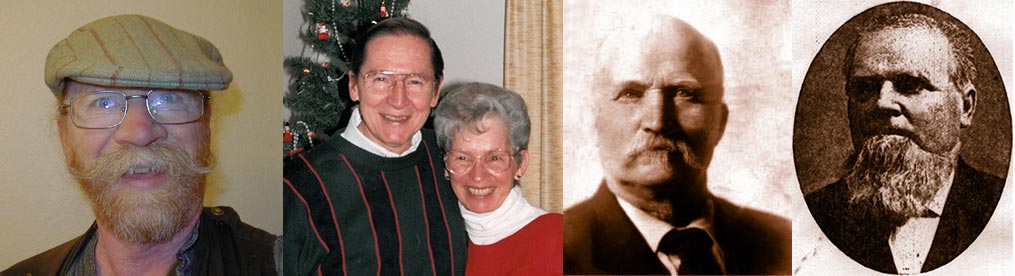
At long last, after retiring from my job and freeing up enough time for the various mundane tasks involved in bringing a book to reality, I have finally published An Orphan’s Legacy: The Descendants of Peter Christian Christensen.
An Orphan’s Legacy
Three-year-old Hans Peter Christensen, later to become known as Peter Christian Christensen, began his arduous trip with his parents across the ocean from Denmark to America in 1853. His parents never finished the journey, his mother dying on board the ship outside of New Orleans and his father dying just as they reached Saint Louis. He crossed the plains as a young orphan to settle in Sanpete County, Utah. His descendants are mostly scattered throughout the western states, and this book relates their life stories. In this book, I have called upon my years of research to collect the stories of three generations of Christensens: (1) Peter Christian Christensen, (2) his children, and (3) his grandchildren.
In the interest of sharing family history, I am offering the digital version of this book free of charge.
An ebook version is available on Google Play and can be accessed here.
If anyone is interested in owning a printed copy of the book, I am offering it for $10.00 (plus shipping) on Amazon. The print version of the book can be ordered here.
The information for the stories in this book came from whatever public documentation I could locate. I am hoping to make this book available to as many Christensen descendants as possible, so that they may share any additional stories that I otherwise haven’t had access to in order to include them in a more comprehensive second edition of the book in the future.
I hope that everyone will enjoy reading my book as much as I enjoyed writing it.
I have posted a couple of stories relating to Butch Cassidy: “Outlaw Annie Thayne” refutes the rumors of my alleged 1st-cousin-4x-removed Annie Thayne being married to the Sundance Kid; and “Outlaw Bub Meeks” describes the life of my 4th-cousin-4x-removed Bub Meeks as an early member of Butch Cassidy’s gang.
I also posted a story about my distant relationship to Barack Obama through the Allred Family: “From the Allreds to President Obama” describes my relationship to Obama through Milford Alexander Allred, the brother-in-law of my 2nd-great-grandmother Ida Christina Johnson Fechser.
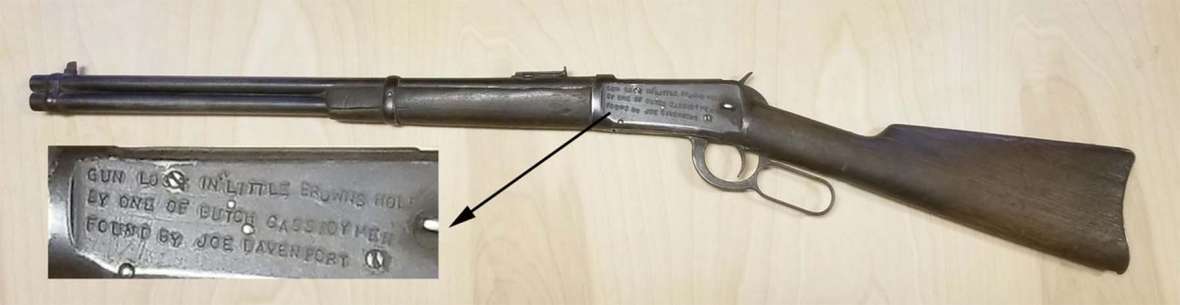
I now have an additional story that links a different member of the Allred family to Butch Cassidy: Sheriff Charles William Allred was once believed to have been involved in killing Butch Cassidy in a case of mistaken identity.
I will begin with the story of Butch Cassidy’s alleged death before I briefly describe my relationship to Sheriff Allred.
This image shows a collection of headlines from various Utah newspapers telling the story Butch Cassidy’s alleged death in 1889.
The Castle Gate Robbery and Related Rewards
On April 21, 1897, the Pleasant Valley Coal Company of Castle Gate, Utah, was robbed of its payroll by two armed robbers, while a third man held their horses. The loss in the robbery was estimated to be about $7,000, and the Pleasant Valley Coal Company offered a $2,000 reward for the return of its money. The two armed robbers were identified as Robert LeRoy “Butch Cassidy” Parker and William Ellsworth “Elzy” Lay. Pleasant Valley paymaster E. Lewis Carpenter also identified Henry Rhodes “Bub” Meeks Jr. and Charles “White River Charlie” Stevens as accomplices.
There was a $500 reward issued by Utah Governor Heber Manning Wells for Butch Cassidy for “robbery of the Pleasant Valley Coal company at Castle Gate in 1897, and other crimes”; and there was also a $500 reward issued by Governor Wells for gang member Joe Walker for “assault with intent to commit murder on Sheriff Tuttle of Emery County, and other crimes.” Sheriff Tuttle’s 1912 obituary said he was “shot by Walker and made a cripple for life,” but although he was seriously wounded it is doubtful his injuries could qualify as crippling. A newspaper described the incident by saying, “Sheriff Tuttle of Emery county, with several others, followed [Walker] to Robbers’ Roost, and attempted his capture. In the fight with him Sheriff Tuttle was badly wounded.” Rewards issued by Governor Wells for other members of Cassidy’s gang totaled more than $4,000. Various other rewards for Butch Cassidy, including the one issued by the Pleasant Valley Coal Company, were estimated to total about $15,000.
There do not appear to be any wanted posters for Butch Cassidy during the period of 1897–1898, but this image shows a Pinkerton Agency carte-de-visite card issued in 1898 with a police photograph from an 1894 mug shot taken at the Wyoming Territorial Prison after Cassidy’s first arrest for stealing horses. This was a pocket-sized card that would be carried by lawmen and bounty hunters searching for a particular fugitive. This photograph was used on most of the later wanted posters for Butch Cassidy.
The Shootout
In May 1898, a posse headed by Carbon County Sheriff Charles William Allred and Emery County Sheriff Azariah Tuttle was organized after a hold-up at the George C. Whitmore Ranch. Following the hold-up, hands from the ranch had been ambushed by Joe Walker and Clarence L. “Gunplay” Maxwell; and Gunplay Maxwell severely whipped ranch hand Billy McGuire with a cartridge belt.
By May 12, the posse had been searching for Butch Cassidy and Elzy Lay for more than a week. Included in the posse were Carbon County Attorney John Wesley Warf; cattlemen George Carter Whitmore and James Montgomery Whitmore Jr., with their ranch hands William “Billy” McGuire and Perry Alonzo Coleman; deputies John Wesley “Jack” Gentry, Peter Anderson, James “Jim” Inglefield, and Joe R. Bush; and lawman John “Jack” Watson (who was also an occasional outlaw and was killed in a gunfight with County Attorney Warf at the Senate Saloon in Price, Utah, later that summer).
At 5:00 on the morning of May 13, 1898, at the head of Florence Canyon, about forty miles north of Thompson Springs, Utah, the posse came upon a campsite with four men, whom they believed to be Butch Cassidy and three other members of the Robbers-Roost/Hole-in-the-Wall Gang: Joe Walker, Elzy Lay, and Gunplay Maxwell. Sheriff Tuttle’s message to Governor Wells stated, “Have killed Walker and Cassiday and captured two others.” Joe Bush’s message to the Governor gave a bit more detail: “Came up with outlaws at 5 this morning. Killed Joe Walker and Butch Cassiday. Captured Lay and one man. Have prisoners and dead men here [Thompson Springs]. Sheriff Allred and posse did nobly.” Bush’s official account, five days later, gave even more details: “After a hard night, climbing steep trails and high mountains, we came onto the robbers at 5 a.m., and ordered ‘Hands up,’ but instead, rifles came instantly into play. The fight was short and lively, perhaps five minutes. The robbers fired from 7 to 12 shots; the posse 50 shots. Butch Cassiday fell first shot through the heart. Joe Walker was the next victim. He was shot through the head, and had four shots through the left arm. Two robbers capitulated. Don’t know their names, but they belong to the ‘Hole-in-the-wall’ gang, Wyoming.”
The two bodies were taken to Price, Utah, where dozens of people who claimed they had known Cassidy and Walker positively identified them at the coroner’s inquest. The two captured men—who identified themselves as S.H. Thompson and William Schultz of Johnson County, Wyoming—were taken to the jail in Price, Utah, pending their preliminary hearing, where they were expected to be charged with horse stealing and then taken to the state prison in Price to await trial. They both stated that the man identified as Butch Cassidy was known to them by the name of John Herring. Twenty-five horses—which the posse believed were from the Whitmore Ranch hold-up—were taken from the campsite and led to Thompson Springs.
This is an image of the burial and funeral expenses for Joe Walker and the person believed at the time to be Butch Cassidy, balanced against the receipts for their property that was sold to offset the expenses.
Identity of Butch’s Body in Doubt
After the shootout, Salt Lake County Sheriff Thomas P. Lewis said he had been given information that Butch Cassidy was not in Utah at the time. He believed that the man identified as Cassidy would later prove to be Tom McCarty—the leader of the McCarty Gang—who was also considered to be Butch Cassidy’s mentor.
The bodies were buried on May 15, but they were exhumed on May 16 so that Sheriff John H. Ward of Evanston, Uintah County, Wyoming—who had arrived in response to a telegram requesting his help—could identify Butch Cassidy’s corpse. Sheriff Ward had been with Butch Cassidy daily for three months while Cassidy was in Ward’s Wyoming jail awaiting trial for horse stealing. Sheriff Ward was absolutely certain that the body was not that of Butch Cassidy. He believed that it might be the body of Bob “Red Bob” Culp, a Wyoming cattle thief. Special Agent for the Rio Grande Western Railroad Cyrus “Doc” Shores also viewed the body and concurred with Sheriff Ward that it was not that of Butch Cassidy. Doc Shores had a good picture of Butch Cassidy, as well as an accurate description from Wyoming Penitentiary records.
When Gunplay Maxwell was arrested for a bank robbery in Springville, Utah, on May 28, he also claimed that the man who was shot and killed by the posse was not Butch Cassidy: “The man who was killed was not Cassidy, but I know who he was; have known him since we were boys. … I’ll tell you what I can do, and will do. If the Governor will give me a chance, or wants me to, I’ll prove to him by some of the best men in this State that Cassidy is not the man killed by those people in the cliffs. I’ll do this by proving beyond doubt who it was they did kill. I know him. If the words of the men I mean are not reliable enough, I will produce the dead man’s wife, his father and his mother.”
Identified as John Herring
William Schultz and S.H. Thompson, the two men arrested after the shootout but later cleared in a trial, had insisted that they knew the dead man by the name of John Herring, and Thompson wrote a letter to the Sheriff of Live Oak County, Texas, where Herring had said he was from. Thompson received the following letter from Herring’s father: “Oakville, Tex., May 31. Mr. S.H. Thompson, Castle Dale, Utah: Dear Sir—Your letter to the sheriff of this county was handed me today. You write of the death of my boy, John Herring. You write as if you were my boy’s friend. Now please write his sorrowing father all the particulars relative to my boy’s death. Did he live any length of time after being shot? If so, did he talk any? Who buried him and where was he buried? Who was he working for at the time of his death? Who took charge of his body and effects after his death? Please, my friend (for if you were my boy’s friend you were mine also), write me fully in answer as to how long he lived after being shot, and if he was conscious at the time of death, and what he said. By doing this you will greatly oblige your sad friend. Curtis Herring.” A few days later, Sheriff Tuttle received a letter from Herring’s brother: “Cotulla, Tex., June 4. To the Sheriff of Castle Dale: Dear Sir—I have been informed that my brother, John Herring, had been killed at Castle Dale. If so, please write me and let me know the particulars about it. Respectfully, Curt Herring.”
During the trial of William Schultz and S.H. Thompson in June, evidence was presented proving that twenty-two of the horses that were sold to bury the two men were the property of John Herring, an honorable young man who could not be charged with any crime and who was wrongfully killed. In July, it was said that John Herring’s father was preparing to file a lawsuit against Sheriff Allred to recover the value of the horses and to clear his dead son’s name.
A headstone was later placed at the gravesite where John Herring is buried alongside C.L. “Gunplay” Maxwell, Joe Walker, and John Montis. Snyder Memorials—which is identified as the supplier of the headstone—was founded in 1929, so it would have been installed in or after 1929. John Herring’s burial plot is shown on the Price City Cemetery records as #1-P-029-02.
Butch Cassidy Returns
In early August, Butch Cassidy was seen passing through Emery County and Grand County, Utah, on his way back to Robber’s Roost from Green River, Wyoming. He appeared to be amused at his obituaries when he stopped and spoke with some people in Castle Dale, one of whom said he was looking well and “sent his regards to a number of people in this vicinity and complimented Governor Wells on his good judgment in refusing the pay the State reward offered for his apprehension.”
The Genealogy of Sheriff Allred
Sheriff Charles William Allred was the second-great-grandson of Thomas Allred (whose father is thought to be the first Allred in Colonial America) through Thomas’s son Moses:
Generation [1]: Thomas Allred (~1725–1810); wife’s name at death was Elizabeth, but she may have been a second wife and not the mother of his children.
Generation [2]: Moses Allred (1769–~1863); son of Thomas [1]; wife may have been Elizabeth Hollingsworth, but this might not be accurate.
Generation [3]: Levi Allred (1800–1870); son of Moses [2]; married Abigail McMurtrey (1804–1887) in 1820; traveled to Utah in 1851.
Generation [4]: William Jackson Allred (1827–1895); son of Levi and Abigail [3]; married Leona Elizabeth Burton (1833–1909) while traveling to Utah in 1851; settled in Sanpete County, Utah.
Generation [5]: Sheriff Charles William Allred (1855–1918); son of William Jackson and Leona Elizabeth [4]; married Emma Jane Williams (1859–1916) on January 15, 1877, in Beaver County, Utah; served as Sheriff of Carbon County, Utah.
My Relationship to the Allred Family
I am related by marriage to Thomas Allred through Thomas Allred’s son William Allred through two different lines.
This tree shows the two Allred lines that link me to Sheriff Charles William Allred.
My second-great-grandmother Ida Christine Johnson Fechser’s sister Inger Elizabeth Johnson was married to Milford Alexander Allred, who was the second-great-grandson of Thomas Allred’s son William:
Generation [1]: Thomas Allred (~1725–1810); wife’s name at death was Elizabeth, but she may have been a second wife and not the mother of his children.
Generation [2]: William Allred (1756–~1824); son of Thomas [1]; married to Elizabeth Thrasher (~1754–~1842; dates come from unsourced histories); served in the Revolutionary War; settled in Bedford County, Tennessee.
Generation [3]: Isaac Allred (1788–1870); son of William and Elizabeth [2]; married Mary Calvert (1793–1861) on February 14, 1811.
Generation [4]: Redden Alexander Allred (1822–1900); son of Isaac and Mary [3]; married Julia Ann Bates (1829–1892; the first of three wives) on December 21, 1843, in Nauvoo, Hancock County, Illinois; traveled to Utah in 1851.
Generation [5]: Milford Alexander Allred (1857–1898); son of Redden Alexander and Julia Ann [4]; married Inger Elizabeth Johnson (1856–1941) on September 16, 1879, in Ephraim, Sanpete County, Utah.
Generation [5]: Ida Christina Johnson (1846–1931); sister of Inger Elizabeth [5]; married Johann Friedrich Fechser (1825–1908; the third of five wives) on January 2, 1864, in Salt Lake City, Salt Lake County, Utah; born in Norway, traveled to Utah with her parents in 1863; Johann Friedrich Fechser, born in Germany, traveled to Utah in 1854.
Generation [6]: Maren Regina Fechser (1880–1919); daughter of Ida Christina and Johann Friedrich [5]; married Peter Angelo Christensen (1875–1924) on December 24, 1902, in Mount Pleasant, Sanpete County, Utah.
Generation [7]: Theodore Angelo Christensen (1903–1981); son of Maren Regina and Peter Angelo [6]; married Reba Cox (1909–1999) on October 11, 1927, in Salt Lake City, Salt Lake County, Utah; moved to Denver, Colorado, about 1950.
Generation [8]: Theodore Paul Christensen (1929–2011); son of Theodore Angelo and Reba [7]; married Carol Madsen (1929–2022) on December 30, 1948, in Elko County, Nevada; traveled to Denver, Colorado, in 1954.
Generation [9]: Eric Van Christensen (1953– ); son of Theodore Paul and Carol [8].
My great-grandfather Peter Angelo Christensen’s brother Randall Christensen was married to Ida Belle Gledhill, who was the third-great-granddaughter of Thomas Allred’s son William:
Generation [1]: Thomas Allred (~1725–1810); wife’s name at death was Elizabeth, but she may have been a second wife and not the mother of his children.
Generation [2]: William Allred (1756–~1824); son of Thomas [1]; married to Elizabeth Thrasher (~1754–~1842; dates come from unsourced histories); served in the Revolutionary War; settled in Bedford County, Tennessee.
Generation [3]: Sarah Allred (~1781–~1861); daughter of William and Elizabeth [2]; married Anderson Ivie (1774–1852) about 1800.
Generation [4]: James Russell Ivie (1802-1866); son of Sarah and Anderson [3]; married Eliza McKee Fausett (1808–1896) about 1824; traveled to Utah in 1848.
Generation [5]: John Lehi Ivie (1833–1909); son of James Russell and Eliza McKee [4]; married Mary Catherine Barton (1837–1888) on May 16, 1852, in Provo, Utah County, Utah.
Generation [6]: Lillie Belle Ivie (1865–1929); daughter of John Lehi and Mary Catherine [5]; married Thomas Gledhill (1856–1933) on January 8, 1882, in Vermillion, Sevier County, Utah.
Generation [7]: Ida Belle Gledhill (1896–1982); daughter of Lillie Belle and Thomas [6]; married Randall Christensen (1893–1928) on October 11, 1916, in Manti, Sanpete County, Utah.
Generation [7]: Peter Angelo Christensen (1875–1924); brother of Randall Christensen [7]; married Maren Regina Fechser (1880–1919) on December 24, 1902, in Mount Pleasant, Sanpete County, Utah.
Generation [8]: Theodore Angelo Christensen (1903–1981); son of Maren Regina and Peter Angelo [7]; married Reba Cox (1909–1999) on October 11, 1927, in Salt Lake City, Salt Lake County, Utah; moved to Denver, Colorado, about 1950.
Generation [9]: Theodore Paul Christensen (1929–2011); son of Theodore Angelo and Reba [8]; married Carol Madsen (1929–2022) on December 30, 1948, in Elko County, Nevada; traveled to Denver, Colorado, in 1954.
Generation [10]: Eric Van Christensen (1953– ); son of Theodore Paul and Carol [9].
My paternal great-aunt Donna Cox Hirth likely had the most exciting day of her life—definitely the most traumatic—on December 20, 1946, when she experienced a carjacking, a kidnapping and a shootout between a burglar and a Colorado State Highway Patrolman, when all she was doing was trying to keep an appointment with her hairdresser. Before telling the story of Donna’s big adventure, I will share the details of her life.
This undated photograph of Donna comes from familysearch.org, where it was shared by her niece Judith Lynne Johnston Wintch.
Short Biography of Donna Delila Cox Gunderson Hirth
Donna Delila Cox was born in Union, Salt Lake County, Utah, on March 23, 1907, the second child of William Moroni Cox (1881–1958) and Minnie Josephine Burgon Cox (1878–1946). She was the sister of Dorothy Josephine Cox Bushnell (1905–1995), Reba “Becky” Cox Christensen (1909–1999), Melba Cox Ball Erickson Geyer (1911–2000), Paul William Cox (1913–1998), Romania “Romie” Cox Johnston (1916–1959), and Claire V. Cox Taylor (1918–2007).
Donna’s father, William Moroni Cox, was a musician who played in a band several days a week for dances and special occasions. He was a big fan of opera, he led the church choir, and he sang in the Mormon Tabernacle Choir. His cornet was his most prized possession, and he was known to say, “If the house ever catches on fire, grab the children and then the cornet, because that’s the most important thing we have.” Although they had very little money and lived in a house that did not even have running water, he bought a piano and hired a piano teacher who drove from Salt Lake City to teach his daughters. In the early years of his marriage, he worked many odd jobs, and later he became the owner of two grocery stores.
Donna’s mother, Minnie Josephine Burgon Cox, was a young girl when she first saw a young freckle-faced red-headed cornet player named William Cox performing at a celebration in the park. She later remembered him and fell in love when they both performed in the Union Dramatic Club, and they were married in Salt Lake City on November 2, 1904. They were divorced about 1935. William married Vernal M. Parker in 1936; Minnie never remarried.
Donna learned an appreciation of music from her father. She and her older sister Dorothy would ride the streetcar to take voice lessons from Professor Alfred Lund (who was the director of the Mormon Tabernacle Choir), and they loved to sing duets together. Donna had a special deep contralto voice and was part of the chorus in the Lucy Gates Grand Opera Association’s 1926 performance of “Carmen” at the Salt Lake Theatre. Donna and Dorothy both sang in the Tabernacle Choir, and Donna was singing with the Tabernacle Choir when they performed at the Hollywood Bowl in Los Angeles in 1926 and when they performed in the Ford Symphony Gardens at the 1934 Chicago World’s Fair.
Donna married Glen Brotherson Gunderson in 1928, and they divorced in 1934. She married Paul Mehl Hirth on December 27, 1935. Donna never had any children of her own, but she was a special “Aunt Dorothy” to her nieces and nephews, who remained close friends with her throughout her entire life. She would take them to lunch at ZCMI or the Hotel Utah, and during the depression years would help buy their school supplies and clothes. She was an avid baker and said that she could count on one hand the bread loaves she had bought from the store.
Donna’s husband, Paul Hirth, was a Divisional Manager at Continental Oil Company, and they both moved to Denver when he was transferred there, and it was only recently after moving there that she had her harrowing experience. After Paul retired, they moved to Long Beach, California, where they both passed away, Paul on September 10, 1974, and Donna on May 12, 1990.
Donna’s Carjacking and Kidnapping
On the morning of Friday, December 20, 1946, Donna (named as Mrs. P.M. Hirth in the Rocky Mountain News) left her home at 1401 Fairfax Street, Apartment 7, in Denver, Colorado, to drive to an appointment with her hairdresser. Before she left her home, the Miller’s Groceteria at 4923 East Colfax Avenue—just two blocks away—was being robbed. An unknown robber arrived at the same time that the Groceteria’s Assistant Manager, Albert Karlsberg, was arriving with two other employees. The robber told Karlsberg he was looking for a job, but after the other two employees had walked off to begin their workday, the robber pulled a gun from his pocket and told Karlberg, “I’m not looking for a job; I want something else,” and forced Karlsberg to open the store safe and stuff the money into paper bags.
This is a contemporary photograph of the Adelon apartment building at 1401 Fairfax Street, where Donna and Paul Hirth lived after they first arrived in Denver.
The robber, with the money in the bags, forced Karlsberg to leave the store with him and walked to the corner of East Colfax Avenue and Elm Street, where they waited nonchalantly for a taxi to come by. When no taxi appeared, the robber climbed into Donna’s car, which had stopped for the red light, showed his gun to her, and told her to “get going.” By this time, the Groceteria’s Manager, Morey Schuster, had heard about the robbery, and he drove from the store looking for the suspect. Schuster saw the robber climb into Donna’s car and began following them. Other witnesses at the scene had given descriptions of the robber and of Donna’s car to the police, and Sergeant Roy Floyd broadcast the descriptions over the police radio.
The robber was urging Donna to speed through town, first west on East Colfax Avenue, then left onto Corona Street, then veering over to one-way Downing Street, still heading south. Manager Shuster tried to keep up with them but lost sight of the car near the intersection of South Downing Street and East Florida Avenue. It can probably be assumed that Donna and the robber turned left onto Buchtel Boulevard South, then right onto South Colorado Boulevard, and right again onto East Hampden Avenue. Near the intersection of South Colorado Boulevard and East Hampden Avenue, Highway Patrolman C.M. Brockway recognized Donna’s car from the description on the police radio and began pursing it.
Donna had been pleading with the robber to let her go, and he allowed her to stop the car in the 2300 block of East Hampden Avenue, and she climbed out. When the robber realized that Patrolman Brockway was pulling up behind them, he also got out of the car and grabbed Donna to use her as a shield as he fired a shot at Brockway. Brockway was afraid of hitting Donna if he fired at the robber, so he fired a warning shot. The robber said, “I’m not a cop killer; throw your gun away so I don’t have to shoot you.” Brockway cautiously circled his patrol car and fired another shot that hit the windshield of Donna’s car. The robber continued using Donna as a shield as he maneuvered himself into position to climb into the patrol car and sped off with Donna as his hostage. Brockway fired another shot that barely missed, then climbed into Donna’s car to continue his pursuit.
The robber, driving the patrol car, turned right on South Lincoln Street and pulled over in the 3400 block of South Lincoln Street, where he ordered Donna to get out and then continued driving. Patrolman Brockway, driving Donna’s car, pulled over to pick Donna up and then lost sight of the patrol car being driven by the robber. Patrolman Brockway and Donna discovered that the robber had left the paper bags containing $2,000 from the Groceteria robbery in Donna’s car. Donna had been held hostage for a total of about 12.6 miles.
Patrolman Brockway’s patrol car was found abandoned in Washington Park at 9:00 a.m. The Denver Police searched the area looking for the robber but could not find him. They continued to be on the lookout for a possible suspect, who was described as age 30–35 years, height about 5′8″, weight 140–145 pounds, light-complected, clean-shaven, and wearing gold-rimmed glasses, tan work pants, and a dark leather jacket. That night, Denver Detective Captain James E. Childers said that he had assigned men to follow several leads but had nothing definite. No further newspaper accounts could be found, so I assume a suspect was never found.
This map shows the probable route taken by the robber after he hijacked Donna’s car. It might not be the exact route, because one newspaper account said they were “frequently dodging into side streets and alleys” during the robber’s flight from justice.
My Relationship to Donna Cox Hirth
Donna Cox Hirth was the sister of Reba “Becky” Christensen, who was the mother of my father, Theodore Paul Christensen.
This tree shows my relationship to Donna Delila Cox Gunderson Hirth.
My mother, Carol [Madsen] Christensen (1929–2022) was the third of ten siblings who survived into adulthood. In that large family of Clint Madsen (1904–1986) and Beth [Fox] Madsen (1906–1985), all the children grew up close to one another, sharing rooms and household chores. They learned how to get along with others by getting along with each other in that crowded household. “There’s twelve of us, an even dozen / and our five-room home is always buzzin’.”
As they reached adulthood, the three oldest girls in the family maintained a close relationship, probably because they all got married and had their oldest children around the same time and were facing the same life experiences. Olive [Madsen] Crowton (1926–2010) and Audrey [Madsen] Stocking (1928–2010) were both married in 1946, and the oldest child of each was born in 1947. Carol was married in 1948, and her oldest child was born in 1949. Over the years, whenever the three of them were able to get together, they were like giggly schoolgirls, just enjoying each other’s company.
Carol, Audrey, and Olive appear in a 1945 portrait with the entire family. This is probably the last family portrait taken before the older children began leaving home to start their own families.
Looking through some of my mother’s old journals, I found the notes she had made during a vacation she took to Southern California with her sisters Olive and Audrey in 1986. This may have been the last wild fling they had together without spouses or children interrupting their revelry.
The Madsen sisters’ road trip, from Denver to Salt Lake City to Saint George to Las Vegas to Barstow to Los Angeles to San Diego and back again.
At the start of her notes on this trip, she wrote: “‘The past is to learn from and not to live in’ —Anaheim 4-13-86.” I assume this is something she read somewhere during this trip and decided it related to their having good times together.
Friday, April 11, 1986
Being the owner of her own business—Luv ’N’ Care Preschool—Carol was obligated to put in a full day of work on the day preceding her little vacation. The day had a less than ideal start when one of her teachers ran out of gas on her way to work. Later that day, one of her students tripped and fell, which knocked the wind out of him. Carol described the incident by writing, “I didn’t know an old lady like me could run so fast.” The little boy was not hurt, but the episode really frightened a lot of the little girls in the class.
Carol’s husband, Ted Christensen (1929–2011), had a birthday coming up. In order to schedule the vacation around the schedules of all three sisters, Carol was going to be out of town for Ted’s birthday. When Carol got home from work, she and her daughter Carolyn held a birthday celebration for Ted. They served pizza, then had cherry pie for dessert. They gave Ted a present of a wooden duck. This may have been his first wooden duck, or it may have been an addition to some he already had, but over the years he collected several wooden ducks. Carol collected clowns, and Ted collected ducks. He enjoyed his present immensely.
It is surprising that she found the time to pack during all this excitement, but she was ready to leave the following morning.
Saturday, April 12, 1986
Carol flew out of Stapleton International Airport in Denver on a Continental jet. At the time, she said it was the biggest airplane she had ever flown on, and she thought it may have been brand new. Sadly, Stapleton Airport is now just a memory for Denverites, as it closed for the opening of Denver International Airport in 1995. Although the control tower still stands, the rest of Stapleton’s acreage has been converted into a neighborhood known as Central Park, which is in both Denver and the suburb of Aurora.
After landing at Salt Lake International Airport, she was met by her sister Audrey, and together they drove to Saint George, where their sister Olive lived. After a long talk, a good dinner, and a lot of silly fun, they went to bed to be prepared to leave in the morning.
Sunday, April 13, 1986
The trio of Madsen sisters drove from Saint George at 8:00 in the morning, and stopped at the Circus Circus Hotel and Casino in Las Vegas for brunch. After dropping some nickels into a few slot machines, they left Las Vegas at noon, stopped to fill the car with gas in Barstow, and arrived in Anaheim at 5:30 in the evening, where they checked into the Best Western Stovall’s Inn of Tomorrow. All three of them were tired and silly. Carol remarked that the traffic in California was “unbelievable,” but she was especially impressed with the Wonderland of Topiary Trees at the Inn of Tomorrow with its trees and shrubs sculpted into animal shapes.
This is an image of a brochure advertising The Wonderland of Topiary Trees at the Inn of Tomorrow. The photograph on the front of the brochure shows Al Stovall, who hand-sculpted the hundreds of plants in the topiary gardens at the Inn.
The sisters had dinner at Coco’s inside the Inn of Tomorrow, then watched a little television and spoke with their brother Earl Madsen (1933–2015) on the telephone before retiring early in anticipation of their upcoming visit to Disneyland.
Monday, April 14, 1986
The Madsen sisters were out of bed at 6:45 the following morning, so they could enjoy a hearty breakfast before they walked to Disneyland, “The Happiest Place on Earth!” They entered through the gates at 10:00 in the morning and were immediately swept up in the mood of the park. There was music playing all around, adults and excited children were staring wide-eyed at everthing around them, and the people working in the park were all pleasant and appeared happy to be doing what they were doing. The sisters browsed the shops and bought a few souvenirs before heading toward the rides.
The “cute little guy” assigning seats on the Pirates of the Caribbean ride told them, “You three look like trouble. We’ll put you in Number One.” They got the full experience, because apparently you get much wetter when riding in the front of the ride. They thought the It’s a Small World ride was beautiful, and they found the Haunted Mansion ride to be scary. While they were riding through the Haunted Mansion in their “doom buggy,” a man dressed in armor began moving toward them. Carol and Audrey screamed in terror, and Olive laughed.
In the America Sings ride—which had been originally created in honor of the country’s bicentennial—they sat in chairs that moved around a circular set of stages where little animated figures sang songs from “The Deep South,” “Headin’ West,” “The Gay ’90s,” and “Modern Times.” They watched the Country Bear Jamboree, and then they ended their visit by seeing only the tail end of a parade because they arrived at a time between the parade shows.
They walked back to the Best Western Stovall’s Inn of Tomorrow, where their brother Earl was waiting on the corner to meet them. They went up to their room to wait for Earl’s wife Kathy to join them for dinner at Coco’s. They all had a laughing good time.
Tuesday, April 15, 1986
Tuesday was Ted’s birthday, so Carol called him long distance to wish him a happy day. There was an extra set of smaller pages included in Carol’s journal for this day that described the events of the day, which she later included in a birthday card to send to him.
The sisters were up early to have breakfast at the Anaheim Sheraton Hotel before going to Cottage Pottery, where Carol bought a set of dishes and had them shipped home, hoping Ted and Carolyn would enjoy them as much as she did. From there, they went to Knott’s Berry Farm, where they visited all the shops. After lunch at Knott’s Berry Farm, they visited the Crystal Factory, the Movieland Wax Museum, and the Hobby City Doll Museum in the downstairs area of the half-scale White House replica at Hobby City. The Doll Museum would have been especially fascinating for Olive, who made dolls during her retirement. Sadly, the Doll Museum closed several years ago, and the White House Banquets and Event Center now operates as an event venue specializing in weddings, quinceañeras, and proms. Cottage Pottery and the Movieland Wax Museum are also now closed.
This photograph of one of the displays in the Hobby City Doll Museum before they closed down comes from the Flicker Photostream of Chris Jepsen.
That night, the Madsen sisters made plans for dinner with two cousins, Lois [Peterson] Ellis (1931–2023) with her husband Louis Ellis (1931–2016), and Dean Peterson (1926–2023) with his wife Betty Jean [Reid] Peterson (1928–2019). Lois and Dean Peterson were children of the sisters’ aunt Lillian Caroline [Madsen] Peterson (1901–1980) and her husband Rudy Peterson (1897–1986).
They began the evening by driving to the Ellis house to see Lois and Louis. They were able to have a visit with their uncle Rudy—who was 88 years old and would pass away later that year—before going to Dean and Betty’s house. From there, they drove to downtown Los Angeles, where Carol, Olive, Audrey, Lois, and Louis would be meeting Dean and Betty in the Union Station parking lot. Because of the parking lot’s proximity to the downtown Post Office and the date of April 15, there were traffic jams caused by last-minute tax filers mailing their returns.
After connecting with Dean and Betty, they walked toward Olvera Street to have dinner. The previous night, President Ronald Reagan had ordered attacks against Libya in retaliation for what he saw as Muammar Gaddafi’s involvement in the bombing of La Belle discothèque in West Berlin, so the parks in downtown Los Angeles were crowded with protesters. After dinner, Carol wanted to go down and take some photographs of the protest. Louis and Dean tried to talk her out of it, but she was stubborn, so they walked with her. As they continued down the street, a banner that one protester was carrying fell down over Carol’s head, and she thought she was being attacked. Her heart was pounding after that.
They very likely had a wonderful dinner and browsed the shops on Olvera Street, but the protest incident was so frightening to Carol that it was the only thing described in her journal entries. They returned to the hotel very late that night, probably too tired to be silly.
Wednesday, April 16, 1986
After eating breakfast at the International House of Pancakes, then browsing the shops at the Disneyland Hotel, the sisters began their drive to San Diego. They stopped at the Pottery Shack (now under different ownership and known as The Old Pottery Place) in Laguna Beach, enjoyed the incomparable coastal scenery along the Pacific Coast Highway, and checked into the San Diego Radisson Hotel about 3:00 p.m.
Their first order of business was to drive to the ocean to take pictures of the rough waves breaking against the rocks. Then, after a supper of hot fudge banana splits in the shopping center across the highway from their hotel, they shopped for beach towels at Montgomery Wards because Carol and Audrey has both forgotten to pack theirs. After a quiet evening of television, they went to bed early to rest up for their trip to SeaWorld.
Thursday, April 17, 1986
The first stop at SeaWorld was to see “Shamu the Killer Whale.” This was not the original Shamu, who died in 1971; but all of the subsequent orcas at SeaWorld used the stage name Shamu, which is trademarked by SeaWorld. The trainers were very fond of the whales and beamed with pride when they performed as expected, but they were not immune from controversy. Due to public concern over shortened life spans due to the stress of captivity and performing, SeaWorld phased out its orca shows and breeding programs in 2016.
They watched the Japanese Village Pearl Divers, and Audrey and Carol each got a pearl from the show. The pearl diving also seems to no longer be listed as a part of the San Diego SeaWorld experience, although it has made a post-pandemic comeback at the Orlando SeaWorld location.
They saw seals (“hundreds of them”), porpoises, and walruses. The highlight of their day was the the Four Seasons Dancing Water show, where colorful fountains created dancing waters while music played in the background. Unfortunately, the Dancing Water shows have also been discontinued at the SeaWorld.
After lunch at The Sea Galley, they left SeaWorld to go to the Old Town neighborhood of San Diego to browse the shops and markets. They got back to the hotel at about 7:00 p.m. It had been a long day, and they were looking forward to relaxing on the beach the next day.
Friday, April 18, 1986
The sisters drove to SeaWorld to have breakfast. Carol thought it would be nice to share their breakfast with the birds, so they each did. They browsed a gift shop, where Audrey bought a few things, before driving again to the Old Town neighborhood.
Their first stop in Old Town was to see the Mormon Battalion Historic Site. The Mormon Battalion was organized for the Mexican–American War, but they never actually fought in the war because they arrived after the fighting had ended in California, so the members of the Mormon Battalion had to conclude their military careers participating in public works projects in San Diego.
From there, the sisters went to “the Antique Doll Store” (probably Old Town Doll & Toy Emporium), which Olive really enjoyed, because making dolls had become one of her interests. After that, they had hot fudge sundaes at a nearby ice cream parlor before driving back to the hotel to get ready for their trip to the beach.
They waded in the ocean at La Jolla Beach, relaxed in the sun on the crowded beach, and took photographs. After that, they drove around the town of La Jolla to see the sights. It was a day for relaxing at the end of a busy vacation. After showering and cleaning up, they treated themselves to a shampoo and set at the Beau Monde Beauty Shop, where Carol discovered Delore Organic Nail Hardener and Nail Polish Dryer and made a note to herself to shop for it later.
They had dinner at the hotel. Carol’s journal says “Alfresco’s” but it is not clear whether that was the name of the restaurant or referred to the al fresco dining style of the restaurant. The sisters spent the rest of the evening trying to squeeze everything into their bags to get an early start on their long drive the following morning.
Saturday, April 19, 1986
The sisters had breakfast in the same restaurant at the hotel before leaving at 8:30. They stopped for gas in Barstow, where they had lunch at Burger King. There was a bad accident near the highway entrance and exit ramps, but it was all cleared away by the time they were on the road again.
They drove across the Mojave Desert. Carol was expecting to see a lot of sand, but it was “just plain ole ground—not much sand.”
They arrived in Las Vegas in desperate need of a pit stop, so Olive suggested they all cross their legs and hop to the nearest rest room, which made them all laugh and made the situation even more dire. They barely made it in time. Each played a roll of nickels in the slot machines at Circus Circus, then after a refreshing drink and candy bar were back on the road.
They reached the Crowton house in Saint George about 6:30 p.m. Olive and her husband Doug Crowton (1925–2011) took them to the Sizzler for dinner, and they walked around Saint George doing some window shopping. One of the shops had some dolls that Olive had made dresses for, so they admired those through the window. They got to bed about 10:00.
Sunday, April 20, 1986
Audrey and Carol left Saint George about 9:30 in the morning. After an enjoyable and uneventful drive, they arrived in Salt Lake City early enough to visit with their dad for about an hour. He often needed someone to lift his mood up, as he had been widowed only a year before. He would also pass away later that year.
Audrey dropped off Carol at the airport early enough that she had enough time to enjoy an ice cream cone and buy a book to read on the plane—James Michener’s The Source.
Monday, April 21, 1986
There is no rest for someone who owns their own business. Carol went to the grocery store at 7:00 and was back at work by 7:45. She taught her preschool class, still feeling the exhilaration of the road trip with her sisters.
Alfred Bernhart Nelson was the oldest of ten children born to two Danish immigrants. Although the Commonwealth War Graves Commission shows his middle name as Burnheart, his homestead records have it as Bernhart, and his signature on those records appears to be Alfred Bernhart Nelson. His probate records also show his name as Alfred Bernhart Nelson.
These three signatures from Alfred’s homestead records—although not 100% legible—all appear to read as Alfred Bernhart Nelson—the way his name is spelled on all of the documents.
Alfred Bernhart Nelson’s father was born October 4, 1872, in Lendum, Hjørring County, Denmark. His birth name was Anton Peter Augustinus Nielsen, but he changed his name to Peter Anton Nelson after coming to America. He arrived in New York, New York, USA, with his brother Niels Christian Magnus Nielsen (who changed his name to Fred M. Johnson in America) aboard the S.S. Norge on April 21, 1890, listing their final destination as Revillo, [South] Dakota, USA. Peter Anton Nelson later returned to Denmark to accompany his future wife when she came to America.
Alfred Bernhart Nelson’s mother was born February 24, 1880, in Tårs, Hjørring County, Denmark. Her birth name was Petrine Marie Pedersen, but she was known as Marie or Mary Peterson in America. She arrived in Philadelphia, Pennsylvania, USA, aboard the S.S. Waesland on March 29, 1897, listing her final destination as Gary, South Dakota, to the home of P.A. Nelson. She was accompanied on this voyage by her future husband, Peter A. Nelson from Gary, South Dakota.
Peter Anton Nelson and Mary Peterson were married April 8, 1897, in Lowe Township, Deuel County, South Dakota, USA. After living in Deuel County, South Dakota, USA, and Ward (later Burke) County, North Dakota, USA, they settled on a homestead in Medicine Hat District, Alberta, Canada. Peter had originally applied for a homestead entry in Canada about December 1908, but forfeited that application before applying again on July 12, 1913. Homestead records show Peter and Mary living continuously on the homestead beginning April 3, 1914. A birth index shows their their ninth child being born in 1915 in North Dakota, USA, so perhaps they had been traveling to South Dakota to visit relatives at that time. A certificate of title for the homestead was issued to Peter Anton Nelson on December 26, 1917. Their tenth and final child was born in Jenner, Alberta, Canada, in 1918. Peter and Mary both died of influenza in Saint Louis, Missouri, USA, in February 1920. Mary had gone to Saint Louis with their youngest son, Orie, who had a club foot, to see a medical specialist. Mary came down with influenza, and when Peter went to Saint Louis to take care of her he also caught influenza.
The Early Life of Alfred Bernhart Nelson
A birth record could not be found for Alfred Bernhart Nelson, but his date and place of birth are entered on his military records as January 3, 1899, in Clear Lake, Deuel County, South Dakota, USA.
This photograph shows a young Alfred Nelson with his parents, Peter and Mary Nelson, and two younger siblings, Anna and Alden. Adapted from a photo supplied by George Capton (nephew of Alfred Bernhart Nelson). George Capton’s public online family trees have been a tremendous source of information about the entire Nelson family, and I am grateful for the amount of difficult research he has been able to accomplish.
Alfred Bernhart Nelson can be seen living with his parents in the 1900 (Glenwood, Deuel County, South Dakota) and the 1910 (Ward Township, Ward County, North Dakota) U.S. Census records, and in the 1916 (Jenner, Medicine Hat District, Alberta) Canadian Census records. Prior to applying for his own homestead, he worked as a farmer on his father’s homestead.
This photograph shows the Nelson home in Jenner, Alberta, Canada. Adapted from a photo supplied by George Capton (nephew of Alfred Bernhart Nelson). George Capton’s public online family trees have been a tremendous source of information about the entire Nelson family, and I am grateful for the amount of difficult research he has been able to accomplish.
The Homestead of Alfred Bernhart Nelson
On April 14, 1916, Alfred Bernhart Nelson filed an application as a minor to reserve a homestead that he could apply for after attaining the age of eighteen years. On February 28, 1917, he filed an application for that previously reserved homestead. There is no record of who worked the homestead while he was in the military, but on December 20, 1921, the certificate of title for the homestead was issued to The Trusts and Guarantee Company Limited in Calgary, Alberta, Canada, as personal representatives of the late Alfred Bernhart Nelson, making it a part of his estate.
The Military Career of Alfred Bernhart Nelson
I can confidently state that Alfred Bernhart Nelson voluntarily joined the military. The Canadian Military Service Act of 1917 provided for the conscription of male citizens between twenty and forty-five years of age, and Alfred was only nineteen years old when he joined. The British Military Service Act of 1916 had provided for the conscription of male citizens between eighteen and forty years of age, but applied only to England, Scotland, and Wales.
On June 3, 1918, Alfred Bernhart attested to enlist in the 1st Military District, 1st Depot Battalion, Alberta Regiment, and was assigned regimental number 3207252. He described himself as single, Lutheran, working as a farmer, living in Jenner, Alberta, Canada, with no previous military experience. He listed his father, Peter Nelson, P.O. Box 7, Jenner, Alberta, Canada, as next-of-kin.
On June 4, Alfred Bernhart Nelson made and duly executed his last will and testament: “I, Alfred Nelson, Regimental Number 3207252, serving in 1st Depot Battn. A.R. of the Canadian Expeditionary Force, do hereby revoke all former Wills by me made and declare this to be my last Will. I bequeath all my real estate unto Mr. Peter Nelson (father), P.O. Box 7, Jenner, Alberta, absolutely, and my personal estate I bequeath unto Mr. Peter Nelson (father), P.O. Box 7, Jenner, Alberta.” The will was then signed by Alfred, witnessed by Privates A.R. Church and J.H. Coventry, and did not designate an executor.
Alfred Bernhart Nelson was given his first medical examination on June 4, with a second medical examination on June 10, and he was categorized as A2—fit for overseas service in terms of physical and mental health. The examination determined him to be in good physical condition, with no vaccinations, 5′9½″, 131 lbs., 34″ chest with 3½″ range of expansion, 20/20 vision in both eyes, normal hearing, a dark complexion, brown eyes, dark brown hair, and no distinctive marks. He received his required vaccinations and inoculations on June 6, 11, and 17.
This photograph of Private Alfred B. Nelson in his military uniform was posted by George Capton (nephew of Alfred Bernhart Nelson) on the Find-a-Grave web site. George Capton’s public online family trees have been a tremendous source of information about the entire Nelson family, and I am grateful for the amount of difficult research he has been able to accomplish.
We can assume that Alfred spent the following two months in training, because the next available record shows him arriving in England on August 15, 1918, aboard the HMS Cassandra. No port is listed, but he probably arrived at HMNB Portsmouth, which would have been the closest British Naval Base to the final destination of Aldershot, Hampshire, England, at approximately 50 miles. On the following day, he was assigned to the 21st Reserve Battalion, Alberta Regiment, in Aldershot.
It is not known whether Alfred actually took part in any military action, because it was less than a month later—September 10, 1918—that he was admitted to the Military Isolation Hospital at Aldershot, described as dangerously ill. His condition was listed as slightly improved on September 18, but on October 7 he was reported to be much worse. Cerebrospinal fluid was withdrawn, which tested positive for meningococci, and he was diagnosed with cerebrospinal fever (meningitis), complicated by hydrocephalus, in which the buildup of fluid causes pressure on the brain.
This photograph of unidentified soldiers and nurses in the doorway of the Military Isolation Hospital at Aldershot was shared on the “Historic Hampshire in Old Photos” Facebook group by Mike Thomas, saying that it was taken by his grandfather, Frank L. Ramshaw, who had been a patient there in 1917. This would have been about a year prior to Alfred Nelson’s being sent there.
On October 8, Alfred was “struck off strength” (officially removed) from the 21st Reserve Battalion, having died in the hospital that day.
The headstone for Alfred B. Nelson: “[Canadian Maple Leaf] – 3207252 PRIVATE – A. B. NELSON – 21ST RES. BN. CANADIAN INF. – 8TH OCTOBER 1918 AGE 19 – [Christian Cross] – IN LIFE BELOVED – IN DEATH LAMENTED.” This photograph was taken for me by Keith Bean, who organizes the annual Remembrance Sunday lighting of the World War I graves at Aldershot (see “Remembrance Day Commemoration in Aldershot” below).
Shortly thereafter, Alfred B. Nelson was interred in the Aldershot Military Cemetery in Aldershot, Hampshire, England. His headstone was engraved with the inscription requested by his father: “IN LIFE BELOVED – IN DEATH LAMENTED.”
The inscription at the bottom of the headstone for Alfred B. Nelson was requested by his father, Peter A. Nelson: “IN LIFE BELOVED – IN DEATH LAMENTED.” This photograph was taken for me by Keith Bean, who organizes the annual Remembrance Sunday lighting of the World War I graves at Aldershot (see “Remembrance Day Commemoration in Aldershot” below).
Medals and Decorations Awarded to Alfred Bernhart Nelson
Private Alfred Nelson was posthumously awarded the Memorial Plaque and the Memorial Cross. They were shipped in 1920 and 1921, after his parents had died, so they were mailed to Aldien B. Nelson, Esq., c/o Mrs. E. Holgerson, Atlee, Alberta, Canada. Alden (also known as Aldien) Bennie Nelson was Alfred’s oldest surviving brother. Mrs. E. Holgerson, in care of whom they were sent, was Alfred’s oldest surviving sibling, Anna Minnie Nelson Holgerson, who was married to Edward Emanuel Holgerson.
The Memorial Plaque—also known as Plaque and Scroll, Deadman’s Penny, or Widow’s Penny—is a bronze, 120-mm-diameter medallion presented to the next-of-kin of British active-duty soldiers killed during times of war. Embossed on the medallion is an image of Britannia, holding a trident and an olive wreath, standing next to a lion, along with two swimming dolphins, encircled by the words, “HE/SHE DIED FOR FREEDOM AND HONOR,” all of which appear above a second lion attacking the Prussian Eagle. The name of the soldier would be embossed in a frame to the right of Britannia.
The Memorial Plaque. This image is adapted from a photo by Gary Blakely on Wikipedia, licensed under the Creative Commons 3.0 license.
The Memorial Cross—also known as the Silver Cross for Mothers—is a sterling silver, 32-mm, slightly-flared-arm cross awarded to the mother, widow, widower, or next-of-kin of a Canadian soldier whose life is lost while on active duty. The top arm of the cross has a St. Edward’s Crown at the end, and each of the other arms has a maple leaf at the end. The monogram “RG”—the Royal Cypher for King (Roi) George V, who was the reigning monarch at the time—appears in the center of the cross within a laurel wreath. The rank, service number, initial, and surname of the soldier would often be engraved on the back. It was originally attached to a long purple ribbon and worn around the neck, but was later replaced with a white–purple–white striped ribbon after World War II so it could be worn as a pin. This would be the equivalent of the United States military Gold Star Lapel Button awarded to families of soldiers killed in action, or Next of Kin Lapel Button awarded to families of soldier killed while on active duty but outside of a qualifying conflict.
The Fold3 website also lists the Victory Medal and the British War Medal as being awarded to Alfred Bernhart Nelson. There is no documentation of them being shipped to his family, but his military history does show his eligibility for them. Any soldier serving in the British and Imperial Forces between August 5, 1914, and November 11, 1918, was eligible for these medals. These two medals were often issued together as a set. When they were worn together, they were commonly referred to as “Mutt and Jeff,” after two popular comic strip characters. When worn in conjunction with either the 1914 Star or the 1914–15 Star—which had been awarded to British and Imperial Forces during the first two years of the war, prior to conscription—they were collectively referred to as “Pip, Squeak, and Wilfred,” also popular comic strip characters of the time.
Mutt, a tall cartoon character, and Jeff, his short friend, were the inspiration for referring to the Victory Medal and the British War Medal as “Mutt and Jeff” when worn together. It is not clear whether one was Mutt and the other Jeff or if they were just known collectively as “Mutt and Jeff.” Pip, a cartoon dog, Squeak, his penguin friend, and Wilfred, their pet rabbit, were the inspiration for referring to the three main Great War medals worn together as “Pip, [1914 Star or 1914–15 Star], Squeak [British War Medal], and Wilfred [Victory Medal]. Both cartoon images come from the U.S. Library of Congress.
The Victory Medal—also known as the Inter-Allied Victory Medal—is a lacquer-coated, bronze, 36-mm disc presented to British and Imperial soldiers in the Great War (now known as World War I). Embossed on the front is a winged Victory (also called Victoria) holding an olive branch in her right hand, with her left hand outstretched. On the back are the words “THE GREAT – WAR FOR – CIVILISATION – 1914–1919 – ……….” within a laurel wreath. The name, rank, service number, and unit of the recipient were engraved on its rim. It hangs from a ribbon that morphs through the colors of the rainbow from violet to red and back again.
The British War Medal is a silver or bronze, 36-mm disc presented to British and Imperial soldiers in the Great War (now known as World War I). Embossed on the front is a left-facing, bare-headed, profile of King George V, encircled by the words “GEORGIVS V BRITT: OMN: REX ET IND: IMP:” (George V, King of all the British Isles and Emperor of India). Embossed on the back is an image of a naked Saint George astride a right-facing horse, trampling the Prussian Eagle and a skull and cross-bones, with the rising sun of victory above the horse’s head. The dates 1914 and 1918 are on the left and right margins. The name, rank, service number, and unit of the recipient were engraved on its rim. It hangs from a ribbon that starts on the left as a narrow blue stripe and a narrow white stripe separated by a very thin black stripe, followed by a wide orange stripe, then a narrow white stripe and a narrow blue stripe separated by a very thin black stripe.
On October 13, 1921, letters of administration and the last will and testament of Alfred Bernhart Nelson, along with his personal property, were granted to the Trusts and Guarantee Company Limited, in order to administer the estate according to the terms of Alfred’s will. This would include $101.36 remaining in his military bank account, his homestead rights, and any additional property he had left behind in Canada. There is no record of who worked his homestead while he was in the military.
His will had named his father as sole beneficiary, but his parents had both been dead for more than a year and half by the time of probate. It would probably take a visit to some Canadian court archives to discover how his estate was settled. He had nine surviving siblings, most of whom were teen-aged or younger at the time of his death.
Remembrance Day Commemoration in Aldershot
Keith Bean—who was kind enough to supply me with the photographs of Alfred B. Nelson’s grave—has organized an annual Remembrance Sunday commemoration at Aldershot Military Cemetery for several years. He and a large group of volunteers place tea lights on the headstones of the hundreds of World War I soldiers buried at Aldershot. The placing of the lights is followed by a ceremony at sundown. Alfred B. Nelson and his comrades-in-arms are thereby remembered every year when the end of the Great War is commemorated.
For Them on the Hill is a short video created by Jason Butcher and Fiona Jones, in which Keith Bean tells the story of how he initiated the lighting of the candles on the WWI graves at Aldershot Military Cemetery.This ITV News report about the lighting of the WWI graves at Aldershot Military Cemetery was filmed on Remembrance Sunday, November 14, 2021, and was aired the following day on the 10 O’clock News.
My Relationship to Alfred Bernhart Nelson
My 4th great grandfather Axel Nielsen (who was born January 29, 1767, in Albæk, Hjørring, Denmark; and died April 12, 1851, in Hørby, Hjørring, Denmark) was the 2nd great grandfather of Alfred Bernhart Nelson. I am descended from Axel Nielsen’s first wife, Anna Laursdatter (who was born November 1, 1764, in Hørby, Hjørring, Denmark; and died May 22, 1809, in Hørby, Hjørring, Denmark). Alfred Bernhart Nelson was descended from Axel Nielsen’s second wife, Karen Olesdatter (who was born February 26, 1786, in Hørby, Hjørring, Denmark; and died April 2, 1869, in Hørby, Hjørring, Denmark).
This family tree shows my relationship to Alfred Bernhart Nelson.
They were a common story when I was in my late teens. The years 1970–1972 averaged at least one airline hijacking per month. There were movies about hijackings, there were jokes about hijackings, there were regular news reports about hijackings, and all the late night talk show hosts mentioned hijackings in their monologues. I was recently surprised to learn that my 3rd cousin 1x removed Gerald “Jerry” Dale Hearn was the pilot of a flight that was hijacked in 1972. It was believed by some investigators that the hijacker might have been the legendary skyjacker D.B. Cooper, who had disappeared with $200,000 ransom money after jumping with a parachute from a hijacked airplane four and a half months earlier, who has still not been found, and whose actual identity remains an unsolved mystery.
The story of the hijacker will be told later in this narrative. First, I would like to share the story of the pilot. One would think there would be more biographical information about the valiant captain of a skyjacked airliner, but I can find only basic family data.
Gerald Dale Hearn
Gerald “Jerry” Dale Hearn was born on October 8, 1929, in Prescott, Arizona, to John Milton Hearn and Anne Egbert Nebeker. He graduated from Prescott Senior High School in 1947, where he played varsity basketball and football, belonged to the Lettermen’s Club, and served as Sophomore Class President. After graduation, he moved to Salt Lake City to attend the University of Utah, where he graduated with a liberal arts degree in 1951.
Gerald “Jerry” Dale Hearn’s high school and college years are documented in this collection of yearbook photos.
Jerry was part of the Naval Reserve at the University of Utah, and took a training cruise aboard the USS Iowa during the summer following his freshman year. My father, Theodore “Ted” Paul Christensen, who was Jerry’s 3rd cousin and the same age, was also on a cruise with the Naval Reserve that summer; but as Ted was in the Naval Reserve at the University of California at Los Angeles, they were probably not on the same ship (I am not sure what ship Ted served on). Ted later transferred to the University of Utah, so they may have known each other, although they might not have known they were distant cousins.
Upon graduation, Jerry was commissioned in the United States Navy as an Ensign. He was promoted to Lieutenant Junior Grade on January 1, 1953, and to Lieutenant on October 1, 1955, and served during the Korean War. I am still trying to determine his exact enlistment and discharge dates. A newspaper article about the hijacking said he had been flying for United Airlines for seventeen years, which would mean he began prior to 1955, but military records show him being promoted to Lieutenant in October 1955. I can only assume that he remained in the Navy Reserves after his discharge. He probably received his flight training in the military, but I have not yet found any documentation of that.
On March 21, 1954, Jerry married Jo Ann Hurt in the home of her parents in Corpus Christi, Texas. After a honeymoon at the Grand Canyon, they set up housekeeping in San Diego, where Jerry was stationed with the Navy. Jerry and Jo Ann had two children who survived to adulthood. They divorced in 1967. Jo Ann appears to have never remarried, and she died on May 2, 1995, in Orange County, California. Jerry remarried in 1975 and had two more children. I cannot find evidence of any other marriages, so it appears that Jerry was unmarried at the time of the hijacking.
His obituary added that he loved to sing and do community theatre and was an active member of the LDS Church in Mesa, Arizona, at the time of his death. Other than that, I could not find any further biographical information.
Jerry died April 13, 2013. Although the place of death is not mentioned in his obituary, I assume it was probably Mesa, Arizona. He was survived at the time by his wife, three sons, one daughter, fifteen grandchildren, one great grandchild, one sister, one brother-in-law, one brother, and one sister-in-law. He was preceded in death by his ex-wife, one son (who died the day he was born), one brother, and one daughter-in-law. He was buried at Mesa Cemetery on April 22, 2013.
This tree shows my relationship to Captain Gerald “Jerry” Dale Hearn.
In order to fully appreciate the heroism of Captain Jerry Hearn’s actions during the hijacking—keeping the passengers and crew safe and relatively panic-free, skillfully handling the large jet at a dangerously slow speed, and safely landing the airplane in Salt Lake City while the aft stairs were open—the entire story of the hijacking needs to be shared.
The Hijacking of Flight 855
My sources of information for this narrative include numerous newspaper accounts from the time; FBI files from the hijacking investigation; the book D.B. Cooper: The Real McCoy, by Bernie Rhodes [who as former Utah Chief Federal Probation Officer was one of the few people to have had extensive interviews with the hijacker after his arrest], researched by Russell Calame [former head of the Salt Lake City Regional Office of the FBI] (1991: University of Utah Press); the “Flight from Justice: The Story of D.B. Cooper” episode of the television show The F.B.I. Files; and a February 2006 interview with Russell Calame conducted by Steven Rinehart on KTKK (K-Talk) radio in Salt Lake City.
On Friday, April 7, 1972, United Airlines Flight 855 from Newark to Los Angeles had one scheduled stopover in Denver. The crew consisted of Captain Jerry D. Hearn, First Officer Ken R. Bradley, Second Officer Kent W. Owen, and three flight attendants, Diane M. Surdam, Marjorie Newby, and Diane K. Sugimoto. Captain Hearn had been flying for United Airlines for seventeen years. Flight Attendant Surdam had been with United Airlines for four and a half years. During their stopover in Denver, most of the passengers had either reached their final destination or were transferring to connecting flights, and they were replaced by new passengers departing from Denver. At that time, the only security measure in place was to check boarding passengers against a profile of hijacker characteristics.
Early news reports stated, “The hijacker pressed a pistol to the head of Capt. Gerry D. Hearn as the jet was high over western Colorado and ordered him to land at San Francisco, where the plane was taxied to a remote runway bordering the bay.” The actual narrative was slightly less dramatic, but nonetheless exciting. In actuality, the pilot later said, “The only contact I had was through instructions in an envelope delivered by a stewardess. There were lots of them, more than 10.” One passenger on the plane, CBS newsman Jim Kilpatrick, said, “The notes that were passed back and forth were all prewritten.” Flight Attendant Surdam later said they were mostly typewritten, although some had been handwritten during the event to accommodate the situation as it developed. One of his demands was that the notes be returned to him so he wouldn’t leave any of them on the plane.
One of the passengers boarding in Denver had purchased his ticket with cash at the United Airlines counter at Denver’s Stapleton International Airport using the name James Johnson (shown as T. Johnson in some reports), having made a reservation by phone a week prior. Nearby passengers eyed him suspiciously. According to passenger Mickey Luckoff, a sales manager for KGO radio station in San Francisco, “He acted very strangely when he first got on the plane. He locked himself in the men’s room and a stewardess had to unlock the door and get him out.” After exiting the men’s room the man took his seat at the rear of the cabin, having changed into a disguise that included dark make-up, reflector sunglasses, gloves, a wig, a fake moustache, and a Band-Aid. The plane left Denver at 2:36 p.m.
Joseph Zaleski, the passenger sitting across the aisle from the man, later recounted, “I saw him open a bag he had and take out a hand grenade and put it in his coat pocket. My heart jumped.” The flight attendant reported the suspicious activity to Captain Hearn, who then planned to make an unscheduled landing in Grand Junction, where FBI agents could be waiting, and he created a story to explain the unscheduled landing to the passengers. One passenger, University of Denver student Robert Mainthow, later recalled, “All these weird things began to happen. We were supposed to land in Grand Junction, Colo., because we had problems with the engine, and then the engine fixed itself. Then, we were supposed to land in Los Angeles, but there was too much smog or fog and we came to San Francisco.”
The hijacker gave the first note to Mike Andria, the passenger seated next to the him, after showing him a grenade and a black .45-caliber pistol. The note said, “This is a hijack. Move forward and get a stewardess.” When Flight Attendant Surdam came to the hijacker, he handed her an envelope labeled, “GRENADE—PIN PULLED. PISTOL—LOADED.” Inside was a grenade pin and a live .45-caliber cartridge, along with two pages of instructions. The instructions started by saying, “WE HAVE A GRENADE, THE PIN HAS BEEN PULLED. WE HAVE PISTOLS, THEY’RE LOADED. WE HAVE C-4 PLASTIC EXPLOSIVES. IT’S A LONG WAY TO THE GROUND.” He ordered the pilot to fly to San Francisco and secure permission to land on Runway 19. He wanted a fuel truck with only two people aboard to be waiting with six hours of jet fuel parked one hundred feet from the nose of the plane on its left. In addition to $500,000 in cash in different denominations, he also wanted four “COMMANDER PARACHUTES” with stop watch and altimeter from “PERRY STEVENS EQUIPMENT COMPANY IN OAKLAND.” He added that any communication from him would be given only to the flight attendant, whom he referred to as “Jane.”
Captain Hearn complied with the orders, radioing the hijacker’s demands to San Francisco International Airport, where United Airlines officials, working alongside FBI agents, assembled the ransom money and parachutes. The serial numbers on all the currency were recorded, and small radio trackers were hidden in the fabric of the parachutes. These parachutes outfitted with radio trackers were referred to as “beeper chutes.” Hearn landed the plane in San Francisco on Runway 19 in a remote part of the airfield away from the terminal, and the hijacker’s instructions were followed, including where the parachutes and ransom money were to be placed outside the plane, as well as the positioning of the fuel trucks. The hijacker also ordered that his luggage be moved from the baggage compartment to the passengers’ cabin.
Seated across from the hijacker was William Richard Coggin, a 21-year-old prisoner who was being extradited from Denver to San Quentin Prison in the custody of Guard Joseph Gonzales for escaping from the Deuel Vocational Institute in Tracy, California. At the start of the flight, Coggin told Gonzales that the man across from them had changed into a disguise in the rest room early in the flight, but Gonzales shrugged it off, thinking Coggin was trying to create a distraction. But Gonzales later became suspicious of the man, and recounted, “I heard him give a piece of paper to a man and say take this to the stewardess.” After the plane landed in San Francisco, the hijacker showed Coggin a note that said, “GO UP FRONT, THE CAPTAIN WANTS TO SEE YOU!” Captain Hearn told Coggin that the hijacker had selected him to retrieve the ransom money and parachutes and bring them onto the plane, which he did, assisted by Captain Tom Davis, an off-duty United Airlines pilot who was deadheading on the flight. The hijacker ordered that the passengers’ luggage be removed, and then ordered that all of the passengers and Flight Attendant Sugimoto exit the plane. He had the one flight attendant leave so the cockpit wouldn’t be too crowded when he ordered the crew to all stay there for the remainder of the flight. The plane had been on the ground in San Francisco for more than three and a half hours. The impatience of the hijacker during the long wait is evident in handwritten notes that were later retrieved: “WHATS GOING ON WITH THAT BAGGAG CART! USE IT RIGHT & STEP IT UP.” “CHECK TO SEE THAT EVERONE IS OFF—CLOSE DOOR. GET OFF GR.”
Flight Attendant Surdam had noticed that two of the three baggage handlers unloading the luggage were wearing dress shoes rather than work boots, which gave away the fact that they were actually FBI agents. Observing the hijacker, she could tell that he had also noticed. Unknown to the hijacker, Flight Attendant Surdam took advantage of this distraction and kept one of his handwritten notes (stating, “EVERBODY OFF NOW EXCEPT STEWARDESS THEY STAY PUT — GET THE HELL OFF THE GD!! BE QUICK ABOUT IT—USE THIS RUNWAY”) and slipped it under her bra strap until she could place it in her purse, where FBI investigators later retrieved it.
Most of the passengers had been unaware that the plane was hijacked until Captain Hearn was given the okay to reveal it in an announcement after they were on the ground in San Francisco: “We have people aboard this plane, more than one, we think, who want to use it for a while. Want the plane for their own personal use. They have asked for a sizable amount of money; and we can assure them now that it’s on its way. They are armed, so stay calm. Please stay in your seats and make no effort to interfere in any way. United Airlines is doing everything it can to get the money and everything they asked for aboard, so it shouldn’t be much longer. Thank you and please bear with us.” This announcement was urgently needed, since some of the passengers were expressing frustration over having to remain on the plane for such a long time after it had come to a stop. One of the passengers, an off-duty flight attendant named Sandra Wilkinson, later said, “I knew there was a hijacking about 15 minutes after we took off because of the stewardess running back and forth.” She described the hijacker as “real composed,” adding, “At no time did he threaten the passengers or even talk to them.”
Off-duty flight attendant Sandra Wilkinson exhibits elation after being released along with the other passengers in San Francisco. Photo from The Hanford Sentinel (Hanford, California), Saturday, April 8, 1972, page 2.
After the plane left San Francisco, it followed a circuitous route—over Coaldale, Tonopah, and Wilson Creek, Nevada; then over Wilford, Hanksville, Marysvale, and Fairfield, Utah; then toward Price, Utah. The hijacker dictated this route with a series of flight plans typed on FAA flight forms, and messages sent to the pilot telling him to climb to 14,000 feet and maintain a speed of 180 knots, which was very slow for the Boeing 727. The hijacker remained in the rear of the passenger compartment, while the small crew remained together in the cockpit. The hijacker could use the service bell at his seat to signal the flight attendant if he decided he needed to send another note to the cockpit.
While the plane was over Tonopah, a light in the cockpit indicated that the aft stairs had been lowered. They crew thought the hijacker might have jumped, but they looked back into the passenger compartment and could see that he was still there. He had jettisoned one of the beeper chutes, which he knew would have been fitted with a radio tracker, in an attempt to fool the FBI into thinking he had jumped and possibly divert their manpower. He later dropped a second beeper chute elsewhere over Nevada to continue his trickery. Captain Hearn radioed the military planes that were discreetly pursuing them to let them know that the beeper chutes that had been dropped were decoys. Since the open door to the stairs would depressurize the cabin, the crew donned their oxygen masks. The military planes had to keep their distance, because the hijacker had said in one note, “I KNOW YOU HAVE CHASE PLANES FOLLOWING. IF I SEE ANY I WILL DETONATE EXPLOSIVES—AFTER I BAIL OUT.”
The hijacker had taped over the peephole in the cockpit door (the peephole that had been mandated on every plane ever since the D.B. Cooper hijacking), but Copilot Bradley was able to monitor the action in the passenger cabin by peeking through a small crack where the cockpit door did not close flush to the doorjamb. He could see that the hijacker had changed into an Army jumpsuit, was wearing an oxygen mask, and had a white towel wrapped over the top of his head. The hijacker had put the ransom money (which weighed about forty pounds)—and any additional items that could later be used as evidence—into a duffel bag that he secured to the parachute harness with D-rings. Other items, such as his disguise and clothing, had been jettisoned over Nevada. A borrowed parachute that he planned on using had popped open early. He had preset it with an altimeter to deploy at 3500 feet in case he lost consciousness during the jump, but it had opened inside his suitcase, so he was using one of the beeper chutes. At 11:12 p.m., Captain Hearn thought he could tell from a surge in the plane’s handling that the hijacker had bailed out. At 11:27 p.m., he reported, “The hijacker, gentlemen, is no longer aboard Flight 855.” FBI Special Agent in Charge Russell Calame passed the information along to his agents: “Our perpetrator has left the plane. He’s now in the air somewhere over Provo.” The hijacker had jumped with a parachute and was believed to have landed somewhere in the mud flats near Utah Lake, in the vicinity of Provo and Springville.
This photo shows the aft stairway that was opened during the flight, allowing the hijacker a jumping-off point. The FAA later mandated that these stairways be fitted with a “Cooper vane” to prevent them from being opened during flight. Photo from The Daily Herald (Provo, Utah), Sunday, April 9, 1972, page 2.
The plane landed safely in Salt Lake City.
These maps show the route before and after the hijacking of Flight 855. Photo from The Ogden Standard (Ogden, Utah), Saturday, April 8, 1972, page 1.
Captain Hearn did not want to disclose very much about the hijacking afterward, saying “It gives people too many ideas about how to do it again. Every time they read about something like this the plans get more sophisticated.” He did, however, say, “The hijacker had an excellent knowledge of jumping procedures, had a very workable knowledge of airplanes and I’d say that he probably was a pilot himself,” adding “I’m inclined to think he used his own parachute,” and, “I’m sure he had an altimeter of his own.” He also said the hijacker appeared to be familiar with the terrain in the area of Utah where he jumped out of the airplane.
Captain Jerry D. Hearn, along with flight attendants Diane Surdam and Margi Newby, speaks to the press after safely landing the airplane in Salt Lake City. Photo from The Herald Journal (Logan, Utah), Sunday, April 9, 1972, page 1.
The Federal Aviation Administration cautioned reporters to use restraint in their reporting to avoid revealing methods used by law enforcement. FAA Rocky Mountain Regional Director Mervyn M. Martin said, “The FAA does not advocate or promote any type of blackout of news regarding the crimes, with one exception—disclosure of strategy.” The $500,000 ransom was the largest ever taken by a hijacker, more than doubling the $200,000 that D.B. Cooper had gotten away with.
Search and Arrest
An extensive search for the hijacker, coordinated by the Utah County Jeep Patrol, lasted during the night and into the morning, including two helicopters with searchlights and flares from Hill Air Force Base. Crews from Tooele, Millard, Juab, and Salt Lake Counties also assisted, as well as officers from the FBI, Provo Police, Orem Police, Utah County Sheriff’s Department, Utah Highway Patrol, and Emergency Radio Patrol. The search was disbanded shortly after 9:00 a.m., but investigators continued to comb the area for any additional clues. Reports of ground flares and a mystery helicopter being seen led to early speculation that the hijacker might have been picked up by a helicopter.
On Sunday, April 9, the FBI announced the arrest of twenty-nine-year-old Richard Floyd McCoy Junior. During a later search of his Provo home, they recovered $499,970 of the $500,000 ransom. Also seized in the search were two military-style flight suits with two aerial flare cartridges in the pockets, a parachute and harness, two helmets, a pistol and holster, two electric typewriters, and various items of clothing. He was charged with air piracy and interference with a flight attendant, which would carry a minimum penalty of 20 years and a maximum penalty of death. After his arraignment, his only comment to reporters was, “It’s embarrassing. Let’s face it.”
A handcuffed Richard McCoy is led from the courthouse following his arraignment. Photo from The Salt Lake Tribune (Salt Lake City, Utah), Monday, April 10, 1972, page 1.
McCoy seemed to be an unlikely suspect. He was a former Mormon Mission Branch President; a recent Mormon Sunday School teacher who preached passionately agains sin; a senior at Brigham Young University majoring in law enforcement; a member of the 115th Engineer National Guard Unit of Murray, Utah; and a veteran of two tours of duty in Vietnam, first as a demolitions expert with the Green Berets when he received a Purple Heart for shrapnel wounds, and then as an aviator, helicopter pilot, and light cargo pilot. He was awarded the Army Commendation Medal with a V for Valor and the Distinguished Flying Cross, among other decorations. He had a wife and two small children. His wife had been a teacher at Provo High School and had recently begun working as a social worker for the LDS Department of Family Services in Provo. Their neighbor Brent Reynolds said, “He is real level-headed and does not seem like the kind of a kid to hijack a plane. He is the type you would like for a friend.” Another neighbor, Norm Cluff, said, “He was a real kind person. He would help push our car out of the snow when no one else would.” Roy Petterman, a BYU graduate student who lived in a nearby basement apartment, said, “He was the type of fellow you could always say ‘Hi’ to and get a response. He seemed to be a warm individual.”
On the same day McCoy was arrested, the FBI thwarted a copycat attempt when they arrested Stanley Harlen Speck of San Francisco at Lindbergh International Airport in San Diego. He had attempted to hijack a Pacific Southwest Airlines Boeing 727 by claiming to have a pistol and a hand grenade, commumicating to the crew through notes, and demanding four parachutes and $500,000. They were able to subdue him when he agreed to leave the airplane to pick up maps and weather information he had demanded. One official commented, “He doesn’t appear to be the smartest hijacker I’ve heard of.” The following months continued to show a significant surge in copycat hijackings.
A cloud of suspicion had been cast over McCoy when his close friend and fellow Utah National Guard helicopter pilot, Utah State Patrol Officer Robert H. Van Ieperen, recalled a casual discussion when McCoy had said it would be possible for someone to hijack a plane by taking their own parachute along, and that if he were to hijack a plane he would “ask for half a million bucks.” Van Ieperen normally would not have remembered the conversation, but McCoy’s sister-in-law had spoken to him on the telephone twice on the night of the hijacking, first at 9:30 p.m. when she inquired if McCoy “were on a mission of some sort,” and later at 11:30 p.m. when she mentioned she was “scared to death” because McCoy had asked her to help him on a hijacking. She later told reporters, “I’ve talked too much already. That’s why I’m leaving. I’m going home to Canton. The U.S. attorney says it’s OK for me to leave. You see, I’ve pleaded the 5th Amendment.” Van Ieperen went on to say that McCoy “flies frequently and is very familiar with Federal Aviation Administration flight plan forms and has access to them,” adding that McCoy had several pistols, and that with his military experience he could possibly have a hand grenade. After receiving this information, the FBI investigators gathered previous samples of McCoy’s handwriting from his school and military records (and later a sample they asked McCoy to provide repeating the words of the hijacking note) to compare them with the hijacker’s note Flight Attendant Surdam had saved. FBI document examiner Palmer G. Tunstall declared it a match. The Provo police said they had reason to believe the hijacker made his getaway in a green Volkswagen with North Carolina license plates. McCoy, who was raised in North Carolina, drove a green Volkswagen with North Carolina plates. William Coggin was interviewed in San Quentin Penitentiary and picked McCoy out of a photo lineup, positively identifying him as the hijacker.
People had trouble positively identifying the hijacker from photos of Richard McCoy because most of them had seen him only after he had donned his disguise. To help with these identifications, an artist from the FBI made a combination (right) of a photo of McCoy (center) with parts of the disguise from the police artist sketch (left). Images come from the the FBI Vault.The FBI handwriting examiner was able to determine that the original note (left) was written by the same man as the sample the FBI asked Richard McCoy to write (right). Images come from the the FBI Vault.
When McCoy was arrested, he was wearing Army fatigues because he was getting ready to go to a National Guard drill in Murray. He told Judge A.M. Ferro at his initial hearing, “I was going to drill this morning, that’s why I have the uniform. I don’t want to embarrass the National Guard or anything.” When the proceedings were delayed, the judge allowed McCoy to go into a separate room and change into a gray vested suit. When he looked at the judge’s light oak desk, McCoy asked, “Is that all they can afford to give you?” It was later discovered that McCoy had spent the entire previous day (immediately following the hijacking) in Guard drills. Utah National Guard Major General Maurice Watts said that he “flew a routine training mission” in a helicopter, flying an Army photographer forty miles to Camp Williams, and came within fifteen miles of the massive search area, but it was unrelated to the ongoing search. It was said that he did not seem tired that morning and did not show any unusual behavior.
McCoy was a regular at Alta Air Park, a local skydiving venue, and instructor William Dause said McCoy had made between thirty and forty jumps there, described him as “an average jumper … by no means an expert,” and said he didn’t remember him ever making a night jump, adding, “He was never an active jumper but he always wanted to be. Never had the money to spare.” He also recalled that McCoy owned his own parachute and would often hang around the park even when he wasn’t jumping. “He was shy. I don’t know if that’s the right word—not boisterous, not a troublemaker; usually kept pretty much to himself.” Dause said that holding airplanes for ransom had become a popular topic of debate among skydivers following D.B. Cooper’s recent crime, and he recalled that in one of those conversations McCoy had said he would use a sport chute rather than a military chute because a sport chute is more maneuverable. “We talked about jumping in an area that would be familiar, about it being a lot safer to have a car parked nearby for the skyjacker to get away.”
United Airlines President Edward Carlson announced that he wanted to see immediate prosecution and substantial sentences—or the death penalty—as a deterrent to air piracy. He also said he would oppose any legislation that would bar airlines from paying ransoms, saying passenger safety was the most important consideration. A federal grand jury issued an indictment for McCoy within a few days.
Trial and Sentencing
McCoy’s mother, Myrtle H. McCoy, drove from North Carolina to Missouri to pick up her other son, and then then continued to Utah to observe the trial: “More’n 3,000 miles; we couldn’t afford to fly. I am his mother, and I’m not ashamed of my son. I don’t condone wrong doings. If my son did it, he went off the beam. He was not rational. He’s innocent as far as I’m concerned. I’ll know the truth when I sit in the courtroom and find out just like you. This is not Richard’s style. He’d give you his shirt if you asked him for it. He’s a very outgoing person. My son’s not a murderer.” Myrtle McCoy sat next to her fiancé in the courtroom, and her son sat next to the fiancé. On the other side of her son was her ex-husband and his new wife. It appeared as if the son served as a barrier between the two families.
My recital of witnesses is based on contemporaneous newspaper articles, although Bernie Rhodes’s book puts some of them in a different order and on different days. I am using the order of witnesses from the newspaper reports, since the newspapers agree with one other and were written at the time it was happening. The order of the witnesses shouldn’t really make a difference to any conclusions, but there is a possibility that some of the order I present may be slightly inaccurate.
The trial of Richard Floyd McCoy began on Monday, June 26, 1972, with Chief Judge Willis W. Ritter, U.S. District Court for Utah, presiding. The first item was a motion by the defense to suppress the evidence obtained through a search warrant by the FBI because the wrong affiant’s name was on the warrant. The judge said he would wait to rule on the motion until any of the questioned evidence was about to be presented. A jury of six men and six women was chosen. The first four witnesses called by Assistant U.S. Attorney James F. Housley were Flight Attendant Diane Surdam, Captain Gerald P. Hearn, Co-pilot Kenneth R. Bradley, and Second Officer Kent W. Owen. Each described the details of the hijacking. Hearn and Bradley said that they had not seen the hijacker, and neither Surdam nor Owen could positively identify McCoy as the hijacker because of the disguise that was worn during the crime.
On the second day of the trial, Judge Ritter said he felt that the error on the search warrant was “prejudicial on its face,” but agreed to hold the motion in abeyance until U.S. Magistrate A.M. Ferro—who had issued the warrant but was presently vacationing in Mexico—could return and be questioned. William Richard Coggin, the federal inmate who had been transported to California on the flight and was one of the men who left the plane to bring the parachutes and ransom money on board, positively identified McCoy as the hijacker. FBI Agent Palmer G. Tunstall compared the hijacker’s note to samples of McCoy’s handwriting and pointed out that he found eleven to twelve points of identification proving the note had been written by McCoy. Another agent testified that a parachute was found in a culvert in Springville, Utah. Four teen-agers identified McCoy as having been seen on foot at the Hi-Spot Drive-In in Springville shortly after midnight. Nancy Bowen testified that she had served McCoy a chocolate malt at the Hi-Spot. Michael Bowen testified that he saw a man who resembled McCoy near the Hi-Spot. Randy Alleman positively identified McCoy as a man he had seen walking toward the Hi-Spot. Peter S. Zimmerman said McCoy paid him five dollars to drive him from the Hi-Spot to Provo. Zimmerman could not remember the address, but said he later led FBI agents to the location where he had dropped off McCoy.
On the third day of the trial, Utah Highway Patrol Officer Robert H. Van Ieperen, recounted his discussions with McCoy about how to conduct a successful hijacking, and spoke about his two telephone calls with McCoy’s sister-in-law on the night of the crime. FBI Agent Charles H. Middleton, who had helped follow the hijacked plane in a Coast Guard chase plane, testified about evidence retrieved from the pouch of the hijacker’s airplane seat after it had landed. United Airlines Ticket Agent at Stapleton Internation Airport Borje E. Sveland testified that he was ninety percent certain that McCoy was the man to whom he had sold the ticket for the flight. Fingerprint expert Roy O. McDaniel testified that fingerprints found on airline tickets purchased by the hijacker and on a magazine retrieved from the pouch of the hijacker’s airplane seat were identical to McCoy’s fingerprints.
The most damning testimony on the third day came from McCoy’s sister-in-law, Mildred Denise Burns, who lived with McCoy and his wife but had been in protective custody ever since McCoy’s preliminary hearing. She began her testimony very nervously and had difficulty talking, and the judge was worried that she might blurt out something about evidence obtained with the search warrant he had not yet ruled on; but finally she became comfortable and was able to tell her story calmly. She said McCoy had talked many times about how he would conduct a hijacking, outlining a step-by-step plan. He told her he was sick of living without enough money and was contemplating hijacking a plane. He offered her $50,000 to pick him up after he bailed out. She had said she would not help him, but he responded by telling her to think about it until the next day. She testified that when Flight Attendant Surdam appeared on a news report after the hijacking, McCoy told his wife, “That’s the girl I gave the hijack notes to and stuck for the money. Just before Frisco, I made her get me a can of ginger ale.” McCoy told Burns that her typewriter might have to be removed from the house and perhaps thrown in the river. He told her details of the hijacking and mentioned that he had wanted to use his own parachute because it “wouldn’t contain a beeper,” but couldn’t because it “started breaking up the suitcase.” He told her he asked for four parachutes to make it look like he wasn’t acting alone. He told her that after he bailed out he went to a drive-in in Springville and offered a boy five dollars to drive him to Provo. Burns testified that she had later seen a large amount of money in a box in a storeroom at the back of the house. She testified that McCoy owned a parachute, rifles and a pistol, a helmet, and “a grenade that wasn’t filled with powder but had a pin.” She testified that when she said she would turn him in if she found he had hijacked a plane, “He said he would kill me and told Karen (Mrs. McCoy) I was to get out of the house.” The defense attorney moved to have Burns’s testimony stricken from the record as being part of the subject of the motion to suppress evidence gathered in the search. Judge Ritter overruled the request, saying her testimony was “outside the scope of the motion.”
Judge Ritter started the fourth day by denying the defense motion to suppress evidence from the FBI search warrant, saying that McCoy was not prejudiced by the search warrant, since McCoy was in the magistrate’s office when the documents were issued and received a copy of them. That left the door open for Assistant U.S. Attorney James F. Housley to introduce evidence about what was retrieved in the search: $499,970 in cash with serial numbers matching those from the hijacking ransom, a skydiving helmet, a flight suit, a glove, an inoperable hand grenade, and an automatic pistol.
The court-appointed defense attorney David K. Winder called four witnesses, Michael Allen Smith, Bryan Wayne Burr, James T. Jackson, and Orville Gunther, who had known McCoy in the Army in Germany, and all testified that McCoy had an outstanding reputation for honesty and not being violent. They emphasized his high spiritual standards and his loving devotion to his children.
On the final day of McCoy’s trial, the United States Supreme Court delivered a ruling in Furman v. Georgia concerning capital punishment, which took the death penalty off the table for McCoy as cruel and unusual punishment. Judge Ritter informed the jury about this ruling prior to sending them to the jury room. This information would help ensure that any anti–capital-punishment jurors would not let the possibility of a death sentence affect their decision.
Following closing arguments, the jury began deliberating at 7:30 p.m., went to dinner at 8:00 p.m., then returned to complete their deliberations at 10:00 p.m. At 11:00 p.m., they returned a verdict of guilty, and McCoy was led out of the courtroom in handcuffs.
On July 10, 1972, Judge Ritter declared, “I hereby sentence you to 45 years in the federal penitentiary,” with no further comment. McCoy would be eligible to apply for parole in fifteen years.
Escape and Appeals
While en route to the federal penitentiary, Richard McCoy was housed temporarily in the Adams County Jail in Brighton, Colorado. On Friday, July 21, 1972, He surreptitiously joined a group of prisoners who were on their way to court, then answered to another man’s name during roll call in the courtroom. He feigned illness and was allowed to go to the men’s room, and then bolted. He was recaptured three blocks away. In what federal officials called “an exercise in futility,” Adams County District Attorney Floyd Marks filed escape charges, which could have brought a one-to-ten-year penalty that would have been served concurrently with his hijacking sentence. This could, however, affect the decision of a parole board when the time came for a parole request. McCoy was then transported to the United States Penitentiary in Lewisburg, Pennsylvania, without further incident.
On February 21, 1973, Attorney Winder appealed the case to the United States 10th Circuit Court of Appeals, claiming the conviction should be reversed because the of the manner in which the FBI collected evidence, saying the affidavit for the warrant was based on second- and third-hand hearsay making the warrant insufficient on its face. In its ruling on May 7, 1973, the three-judge court disagreed: “In determining the sufficiency of an affidavit, the test is whether the affidavit sets forth sufficient underlying facts and circumstances to the end that the magistrate can make a detached judgment as to the reliability of the various source of the affiant’s information. The affidavit in this case measures up to that test.” In response to the argument that the magistrate had mistakenly misidentified the affiant, the court agreed with the original judge, saying, “We do not believe the misidentification of the warrant of the affiant in anyway prejudiced McCoy.”
On May 21, 1973, a Utah man named Larry Patterson filed a suit in the United States District Court seeking damages of $535 from the FBI for their mistreatment of a parachute that he claimed to have loaned to Richard McCoy. His claim said that the parachute was wet and that he had asked the FBI to dry and properly fold the parachute, which they refused to do, rendering the parachute worthless. He had previously filed a complaint with the acting director of the FBI, but no action had been taken. I could find no more reports concerning this suit, so I am assuming it was dismissed.
On October 10, 1973, McCoy’s attorneys appealed to the United States Supreme Court, claiming that McCoy had been the victim of illegal search and seizure and that the Appeals Court ruling conflicted with rules previously spelled out by the Supreme Court. On December 6, 1973, the Supreme Court denied the hearing without comment, allowing the original conviction to stand.
Second Escape and Death
At the United States Northeastern Penitentiary in Lewisburg, Pennsylvania, McCoy became friends with Melvin Dale Walker, who was serving fifty-five years for numerous bank robberies and multiple escapes. Walker was known for working with his hands, so McCoy smuggled him some artist’s wax and magazine photos of an Army .45-caliber pistol, and Walker spent a day creating a wax model of a pistol, with details all the way down to the screw heads and grooves in the handle. McCoy used it to make a mold to create a fake pistol out of dental plaster, which they then painted a bluish-grey to resemble the metal of a genuine gun.
McCoy had large ears that protruded from his head (a trait he shared with the still unidentified D.B. Cooper), and he convinced one of the prison doctors to have him transferred to the Medical Center for Federal Prisoners in Springfield, Missouri, to have surgery to make his ears smaller and flatten them against his head in order to quell his feelings of personal inadequacy. After the procedure, he attempted an escape from the Medical Center and was sent back to Lewisburg. When he returned, he told Walker, “The FBI’ll have to look twice now.”
The Federal Rules of Criminal Procedure allows for a judge to modify a sentence after 120 days following a final appeal. Judge Ritter let an additional several months pass before considering McCoy’s request for a sentence reduction, which he denied on July 19, 1974.
At 9:25 a.m. on August 10, 1974, Richard McCoy and Melvin Walker escaped from the Penitentiary in Lewisburg, Pennsylvania, along with two other inmates, Joseph William Havel and Larry LeRoy Bagley, who were both serving sentences for armed robbery. The four men commandeered a garbage truck that was waiting in the “sally port” at the prison. The sally port was a controlled entry to the prison consisting of a large area between two gates that are never open at the same time to prevent there ever being a direct escape route. They climbed the fence from the yard into the sally port, used their fake gun to intimidate the guard on the truck and used knives to intimidate the trustee who was driving the truck, then they crashed the truck through both gates before driving off. Prison officers were delayed in their pursuit by the broken inner gate blocking their exit. Tower guards fired about seven shots in an attempt to disable the truck, but they bounced off the garbage compactor on the truck. The escapees were wearing Army fatigues underneath their prison garb so they could discard their prison clothing and look like typical citizens.
They hid the truck in a heavily wooded area and walked about a quarter of mile to where they saw Frank P. Whittle outside the farmhouse owned by his mother-in-law, Mary Mook, where he was preparing to take Mrs. Mook, her housekeeper Catherine Flad, and his wife Geraldine, on a shopping trip. They said, “We want to borrow your car,” to which he responded, “You’re kidding,” but he knew they were not kidding when he saw the knives hanging from their belts. The four convicts tied up the four people with twine in their kitchen before taking Whittle’s car. Mrs. Mook later commented, “They never raised their voices or said anything nasty. They were just so nice. One of them told me he had three children. And they didn’t even tie us tight.” Whittle was able to get loose quickly and waited for the convicts to drive away before running to a neighbor’s house a quarter mile away to call the police, because the convicts had cut the phone line. His wife later said, “He didn’t even bother to untie us. We had to unloosen ourselves while he was gone.” The car contained about $250 worth of camera and movie equipment, new fishing equipment, and some baby gifts that the Whittles had planned to take to Philadelphia, which may have helped finance the next leg of the convicts’ journey.
Police searched the area for more than twelve hours, cruising the streets, interviewing nearby residents, calling in search helicopters, searching more than a hundred cabins in the area, setting up roadblocks, and alerting the public to keep their eye out for the stolen 1970 bluish-green Ford Fairlane with Pennsylvania plates 1H7-306. Pennsylvania State police set up a command post in a Mifflinburg grocery store. The Union County Sheriff and his Deputies searched numerous lesser-known locations in the area. They received numerous tips by phone, but nothing panned out. A local bloodhound owner was anxious to get his dogs involved in the search, but never got the chance. The convicts had disappeared and seemed be headed toward North Carolina.
On August 13, 1974, a branch of the Bank of North Carolina in Pollocksville, North Carolina, about twenty miles away from McCoy’s hometown of Cove City, was robbed by four armed men who got away with about $10,000. The getaway car, a green 1970 Chevrolet, had been stolen at New Bern, North Carolina, the night before, but the men immediately abandoned it and switched back to the Fairlane, which now sported stolen Ohio tags. A Highway Patrol helicopter spotted that car on an unpaved logging road in the Great Dover Swamp near Cove City, and descended to check it out. Four men jumped out of the car and fired a gun at the helicopter before running into the nearby woods. Two of the men, Joseph Havel and Larry Bagley, were later apprehended, but Richard McCoy and Melvin Walker were believed to be hiding in the snake-infested swamps.
Anyone familiar with the Hatfield-McCoy feuds knows how loyal the McCoys are to their kin in that part of the country, even today. Cove City Mayor Charles McCoy, a distant cousin of Richard McCoy, predicted that he could not be caught in the swamp, saying, “It’s like throwing a rabbit into a briar patch—it’s like home to him. He could tell you which way the water runs in which ditch or stream. He used to go into the swamps with his brother just to see who could catch the most snakes barehanded and pop their heads off.” Virgil Thompson, who lived on the edge of “McCoy Country,” said “A lot of people around here would help him. All of his kin would.” His mother, however, said, “I would feed him and clothe him and then take him to the county sheriff. I don’t want to see my son shot.” But she then defended him by saying, “He didn’t hurt anybody if he did the hijacking. He has never hurt anybody in his life.” The scratched and muddied law officers who searched thousands of acres of swampland believed they were not getting the aid that they could get if McCoy were hiding in territory where we was not so well liked. Edward J. Krupinsky, Special Agent in Charge of FBI Operations in North Carolina, said, “Let’s put it this way: the relatives have been somewhat less than cooperative.”
They appear to have headed west for a while. Using Virginia as their home base, they traveled to Indiana, Tennessee, Missouri, Georgia, and Alabama. They robbed the Bank of Maryville in Maryville, Tennessee, on September 4, 1974, getting away with about $74,000. Walker was on the FBI’s ten-most wanted list and was described by former prison associates as someone “who would kill at the drop of a hat.”
Acting on a tip, FBI agents staked out a house in Virginia Beach, Virginia, where the two men were believed to be living. Agents were waiting inside the house when McCoy and Walker came home at 11:30 p.m. on Saturday, November 9, 1974. FBI Spokesman John Coney reported, “McCoy opened the front door and at that point an agent inside [Special Agent Nicholas O’Hara] identified himself and told him to hold it and then to come in. After about a split second he pulled his revolver. He got one shot off and the agent returned fire. It blasted him right out the front door.” McCoy’s shot had hit a wall inside the house. The force of the shotgun blast knocked him out of the house. The FBI agent who rushed in to attempt to give medical aid to McCoy, and in whose arms McCoy died, was described by Russell Calame as “a good Catholic boy named Joseph Smith,” an ironic ending to the life of a man who was agonizing over his excommunication from the Mormon church for his crimes. Melvin Walker was returning to the house after driving around to survey the neighborhood, but sped off when he heard the shots and was apprehended about a half mile away. “Two units pulled him over at gunpoint. He had two loaded weapons in the car, but he chose to surrender.” An arsenal of firearms and ammunition was discovered in the house, along with military rations and marked money that could be traced to the Tennessee bank robbery. McCoy had rented the house in September, using the name Herbert J. Moon, using stolen identification.
A funeral was held for Richard F. McCoy Jr. on Wednesday, November 13, 1974. He was buried in a plot on his mother’s farm in Cove City, North Carolina.
In May 1975, McCoy’s widow, Mrs. Karen McCoy, attempted to establish her claim on his estate, which consisted of a half-interest in $12,000, a 1971 Ford LTD, a houseful of furniture, some diamond jewelry, an arsenal of weapons including submachine guns, a quantity of marijuana, television sets, and several race horses, all allegedly stolen or purchased with stolen money. This case opened up the question of whether FBI agents had violated McCoy’s rights when they entered the house without a warrant; they had climbed through a garage window. The owner of the house had given them keys, but they did not work because the locks had been changed. FBI Agent Nicholas O’Hara said the agents did not need a search warrant because they were working on probable cause that one of the men was in the house. I could find no records of final rulings on either the estate claim or the possible violation of rights.
Was D.B. Cooper the Real McCoy?
There was early speculation that Richard McCoy and D.B. Cooper were the same person, based on similarities between the two hijackings. When Russell Calame retired as Salt Lake’s FBI Special Agent in Charge, his successor, Maurice Slocum, was not interested in investigating the McCoy-Cooper connection and let it slip between the cracks. Slocum was later demoted and transferred to the Detroit office under less than honorable circumstances. Bernie Rhodes commented in his book, “I believe … that when Maurice Slocum … chose to chase women instead of Calame’s hypothesis, he was playing, like the Reno agents, into D.B. Cooper’s hands.” Bernie Rhodes and Russell Calame remained convinced of the connection.
In January 1986, Rhodes filed a Freedom of Information request to obtain FBI records. He and Calame were writing a book, and Rhodes said he needed 32 pages of records concerning McCoy that the FBI had withheld from him. In a letter to the FBI that he attached to the complaint, he wrote, “From my conversation with McCoy, his wife, your agents at the time of the offense and recently, to the prosecutor at the time and defense counsel, I was convinced then as I am now that Richard Floyd McCoy Jr. and Cooper are one and the same.”
Prior to the publication of D.B. Cooper: The Real McCoy, by Bernie Rhodes, researched by Russell Calame (University of Utah Press, 1991), an item in the Davis County Clipper (Bountiful, Utah) by columnist Brian Gray talked about the book mentioning Gray’s friend, Utah lawman Harry Jones, as the man who “actually captured the notorious D.B. Cooper.” He quotes Jones in his column: “There was talk even then that McCoy and Cooper were one and the same person. The plan was basically the same, McCoy’s description matched Cooper’s and ironically McCoy and Cooper both reserved the same seat on the airplane. McCoy, highly-trained in special forces military tactics, was technically a genius. To McCoy, the money was never the issue. In his mind, the hijacking wasn’t a criminal attempt, but simply a challenge. It was a chance to show people how smart he was. Even during his escape, he was involved in two bank robberies and was planning another airplane hijacking. The man had no conscience. As far as the first hijacking, he would have got away with it, too. If he had not bragged to his buddies, he could have remained unidentified.” At the mention of Hollywood making a movie out of the book, he said, “If they do, I hope they hire an actor who looks like me,” to which the columnist quipped, “But they probably won’t. They’ll most likely hire an actor who has hair!”
These to photos show a comparison between a photo of Richard McCoy and an artist’s sketch of D.B. Cooper. Photo from The Daily Spectrum (Saint George, Utah), Friday, December 1, 1989, page 1.
Rhodes’s book cites several similarities between McCoy and Cooper: They looked similar; each hijacked a Boeing 727, which was the only commercial aircraft with an aft stairway that could be opened during flight to be used as a jumping off point; each sat in the rear of the coach section on the right side of the aisle; each asked for four parachutes; each used the phrase “no funny stuff” in a ransom note; each showed a knowledge of pilot terminology and used FAA flight forms to give instructions; each released all passengers after receiving money and parachutes; each parachuted in the dark; and each hijacking occurred during a vacation break at Brigham Young University, where McCoy was a student. The book also disputes McCoy’s alibi of being at home on Thanksgiving in 1971, where his sister-in-law placed him between 2:00 and 6:00 p.m. The FBI had determined through credit card records that McCoy had filled his car with gasoline in Las Vegas at Thanksgiving time, and that a collect call had been placed in Las Vegas to his home in Provo on Thanksgiving day. The authors theorize—as did some previous FBI investigators—that McCoy drove from Provo to Las Vegas, flew to Portland, boarded the flight to Seattle, hijacked the plane, parachuted out, walked back to Portland, flew back to Las Vegas, and drove home to Provo, which he could have done in time for a late afternoon dinner. The most convincing piece of evidence was a clip-on tie and a pearl tie tack that D.B. Cooper had left on the seat of the plane he hijacked. The mother-in-law and sister-in-law of McCoy each identified them in interviews with FBI Agent Jim Thiesen as having belonged to McCoy, although the FBI was unable to find any additional evidence—such as photographs—linking the tie to McCoy. Rhodes said that in a pre-sentencing interview, McCoy neither admitted nor denied guilt in the Cooper hijacking.
On February 4, 1992, a judge issued a restraining order halting sales of the book, based on a complaint by McCoy’s widow that the book was full of lies and violated her right to privacy. An emergency Utah Supreme Court hearing lifted the order a few hours later. On Thursday, February 20, 1992, a ruling by 3rd District Court Judge Homer Wilkinson refused to ban further sales of the book, saying “It’s not something now that can be pulled back by an injunction.” He did, however, place limitations on what could be included in any movie made from the book. Attorney David Watkiss Jr., speaking for the authors, argued that the book was being written since 1985, and Karen Burns McCoy had done nothing to stop its publication until October 1991. He said, “She didn’t do anything and now it’s out, the damage is done.” During testimony, Mrs. McCoy did admit to helping prepare McCoy’s disguise, and to driving him to Salt Lake International Airport, where he boarded a flight to Denver: “He said to me, if I didn’t help him, he would take away my babies. And I knew he would. I was not going to risk my babies.” She denied allegations raised in the book that she drove a getaway car in his prison escape, that she dated an FBI agent, that she conspired with the FBI to have her husband killed or captured, or that she threatened to throw her daughter under the wheels of a truck: “I was not unfaithful to Richard McCoy. I did not help have him killed. I feel like I’m barely holding on, and I have worked to hard to hold on.” Judge Wilkinson ruled that any movie made from the book would be prohibited from including those specific allegations.
Karen Burns McCoy also filed a defamation suit against Bernie Rhodes, Russell Calame, the University of Utah Press, and Provo lawyer Thomas Taylor. She had included Attorney Taylor in the suit for violating attorney-client privilege by sharing information with the authors. Taylor maintained that he was neither Mrs. McCoy’s attorney nor her literary agent, but that she had given several interviews to him and talked about collaborating on a book, and that he gave Rhodes and Calame his files out of friendship. They settled out of court in January 1994. The publisher settled for $20,000; Attorney Thomas settled for $100,000; The settlements of Rhodes and Calame were confidential. The earlier injunction prohibiting allegations about Mrs. McCoy from being included in any future movie would become void with the settlement, but it was not revealed whether similar terms may have been included in the settlements.
In 2017, a group of amateur scientists revealed some additional evidence concerning D.B. Cooper. They analyzed particles removed from the clip-on tie Cooper had left on the plane. An electron microscope revealed several rare earth elements, including cerium, strontium sulfide, and pure titanium. These elements were rarely used at the time, but would have been used in Boeing research labs and manufacturing facilities, where they were developing cutting edge monitors, such as radar screens, that used those elements. They conjectured that Cooper may have been an engineer or manager in one of the plants, or had at least visited them in some capacity. It is not known whether the FBI has followed up on this new evidence. The Bureau had announced it was no longer actively investigating the D.B. Cooper case in July 2016. It has been suggested by some later researchers that these elements were not as rare as the original analysts said they were and could have been picked up from a number of manufacturing locations.
Conclusions
Rhodes and Calame may or may not be correct in their conclusion that Cooper and McCoy were the same man. They set up a plausible scenario describing how they believed McCoy had committed the Cooper hijacking. Then they listed all the similarities between the two crimes, including things that had been withheld by the FBI that McCoy could not have known if he weren’t D.B. Cooper. Finally, they demonstrated improvements in strategy that McCoy could have developed following mistakes made in the first attempt. Their case is very convincing, but since it is mostly based on circumstantial evidence, there can be room for reasonable doubt. There are many additional theories about the identity of D.B. Cooper, and many of them are also quite convincing. I would have to say there is a hung jury in this trial.
During the fall 1971 semester at Brigham Young University, Richard McCoy had experienced some medical issues that were diagnosed as severe migraine headaches or a possible brain tumor. With less than a year to graduation, he knew he would probably not be employable in his chosen fields of law enforcement and/or aviation, and he was despondent. He considered suicide to be undignified or cowardly, but said he would not go out of his way to avoid a potentially deadly situation. This state of mind may have contributed to his crimes.
Later in 1972, the Federal Aviation Administration mandated that aircraft with aft stairs be fitted with a device to prevent the stairs being opened while the airplane was in flight. This came to be known as a Cooper Vane. This is just one of the earliest steps that have evolved into the numerous security features we have become so familiar with at airports today.
The population of Springville, Utah, at the time of the hijacking was about 8,000. The biggest news story to ever hit the area had a large impact on that normally quiet town. My cousin who was a student at Springville High School at the time recalled, “It was the big talk at school, and everyone wanted to hang out at the Hi Spot because it was the ‘spot’ of a sensational crime! Big news for a small town!”
Captain Gerald “Jerry” Dale Hearn should be honored for his valiant service in this emergency. He followed the airline’s protocol mandating that the safety of the passengers be the ultimate concern. He handled the situation in such a calm way that most passengers did not even know they had been hijacked until they were on the ground in San Francisco, and those that were aware of the hijacking were not overly panicked. When the hijacker demanded the airplane keep a steady speed of 180 knots, Captain Hearn oversaw the expert handling of the Boeing 727, despite flying at a speed below that recommended for a plane that size. He was able to communicate effectively with the Coast Guard pilots and FBI agents who were monitoring the flight but had to stay back far enough to avoid being seen by anyone in the airliner. He had enough of a feel for the jet that he could tell by its handling when the hijacker had jumped, and relay that information to officials on the ground. Finally, he landed the jet without incident at Salt Lake City International Airport, despite the fact that the aft staircase has been lowered during flight. He was truly the hero of Flight 855.
While researching one’s genealogy, it is exciting to find a connection to English royalty, but after finding many connections one begins to realize that just about anyone with British ancestry has a connection to royalty at some point. Finding an ancestor who served in the Revolutionary War is also exciting, but after finding many more connections one again realizes that just about anyone with ancestry from colonial days has an ancestor who served in the Revolution.
Another connection may be more elite: an ancestor who arrived on the Mayflower in 1620. Evidence shows that I am descended from William Bradford, who not only arrived in America on the Mayflower, but also was elected as the governor of the Plymouth Colony for most of his life.
Several of my matches on various DNA sites have trees showing a lineage from William Bradford through his great-grandson William Lisk. DNA connections through an ancestor that distant are tenuous at best, but there are enough of them that I felt comfortable reaching the conclusion that I was descended from William Bradford and William Lisk. I tried sending my ancestry record to The Mayflower Society for a Preliminary Review, but their requirements for documentation (birth records, marriage records, and death records) are too strict for my circumstantial evidence to be accepted by them. However, I still believe I have enough circumstantial evidence to show my connection to William Bradford.
Vague Documentation
Three generations need more documentation to satisfactorily prove the entire line to The Mayflower Society: Edward Williams Fox, Caroline (Lisk) Fox, and Bradford Lisk.
Edward Williams Fox
According to his death certificate and various family histories, my second-great-grandfather Edward Williams Fox was the son of David Williams Fox and Caroline Lisk, who were both born in Adams, Jefferson County, New York.
The death certificate of Edward W. Fox: “State Board of Health File No. 48 ¶ State of Utah—Death Certificate ¶ Place of Death: ¶ County of: Sanpete ¶ Precinct of: Manti ¶ City, Town or Village of: Manti ¶ Full Name of Deceased: Edward W. Fox ¶ Former or Usual Residence: Manti, Utah ¶ How long resident at place of death: about 55 yrs. ¶ Sex: Male ¶ Color: White ¶ Date of Birth: August 1, 1833 ¶ Age: 77 Years, 7 months, — Days ¶ Single, Married, Widowed, or Divorced: Married ¶ Birthplace: (State or country) New York ¶ Name of Father: David W. Fox ¶ Birthplace of Father (State or country): Adams, N.Y. ¶ Maiden Name of Mother: Caroline Lisk ¶ Birthplace of Mother (State or country): Adams, N.Y. ¶ Occupation: Surveyor ¶ Informant: Jesse W. Fox ¶ (Address) Manti, Utah ¶ Place of Burial: Manti Cemetery ¶ Date of Burial: March 6, 1911 ¶ Undertaker: John P. Sorensen ¶ Address: Manti, Utah ¶ Medical Certificate of Death ¶ Date of Death: March 1st, 1911 ¶ I Hereby Certify, That I attended deceased from June 1910, to February 1911, that I last saw him alive on February 20, 1911, and that death occurred on the date stated above at –m. The Cause of Death was as follows: Chief Cause: Cardiac arrhythmia ¶ Where Contracted: Manti ¶ Duration: — Days. ¶ Contributary (if any): Arterio Sclerosis ¶ Where Contracted: Manti ¶ Duration: Yrs. ¶ (Signed) Wm. A. Olsten M.D. ¶ Date: March 3, 1911 ¶ (Address) Manti, Utah ¶ Filed: March 6, 1911 ¶ Parley Nelson Registrar ¶ Registered Number: 10 ¶ No of Burial Permit: 10.”This is the opening of a history of Edward W. Fox presented by his daughter-in-law, Olive Mae Lane Fox, at a Fox family reunion in 1962, naming Edward’s parents as David W. Fox and Caroline Liske: “HISTORYOFEDWARDW.FOX ¶ (Presented at Fox Family Assn. Reunion – April 9, 1962 – – – – by Olive Mae Fox ¶ Edward William Fox was born in Philadelphia, New York, August 1, 1833. He was the son of David W. Fox and Caroline Liske. David was a carpenter, and joined the Mormon Church early in the 1840’s and moved to Nauvoo. He was a brother to Jesse W. Fox, Sr., and was fourteen years older than Jesse. ¶ David was born August 10, 1805, at Adams, N.Y., and died at Nauvoo, Illinois, October 25, 1945. Caroline Liske, his wife, was born at Adams, N.Y. August 21, 1808, and she died at Nauvoo, Illinois, November 15, 1845, three weeks after the death of her husband.”
The Nauvoo Community Project web site lists Edward’s parents as David Williams Fox and Caroline Lisk, but does not give any supporting documentation.
The Nauvoo Community Project web site listing for Edward Williams Fox: “Nauvoo Community Project ¶ Family Search ID: LHP8-GCB ¶ Foundational research has been completed for this person. ¶ Additional research will be conducted in the future. ¶ Edward Williams Fox ¶ Birth 1 August 1833 Philadelphia, Jefferson, New York, United States Citation(s) ¶ Death 1 March 1911 Manti, Sanpete, Utah, United States Citation(s) ¶ Burial 6 March 1911 Manti Cemetery, Manti, Sanpete, Utah, United States Citation(s) ¶ Father David Williams Fox ¶ Mother Caroline Lisk.”
The 1840 United States Census does not give names of individual children, but there is a male aged five through nine years in the household of David W. Fox in Adams, Jefferson County, New York, who fits Edward’s age (seven years) at the time.
The listing for David W. Fox in the 1840 United States Census shows Edward Williams Fox as a male member of the household aged five through nine years. The listing directly below David W. Fox shows his father, Samuel Fox; and the listing nine lines below David W. Fox shows his father-in-law, Bradford Lisk.
If I could prove the other connections, I would hope that Edward’s death certificate would be adequate proof for the Mayflower Society that Edward Williams Fox was the son of Caroline Lisk.
Caroline (Lisk) Fox
According to various family histories, Caroline Lisk (the mother of Edward Williams Fox) was the daughter of Bradford Lisk and Jerusha Lewis, but it is not clear whether these histories are from personal knowledge or from hearsay. There do not seem to be any birth or baptism records to verify the facts, so we must rely on these histories, which are generally accepted by family historians. The Nauvoo Community Project web site lists Caroline’s parents as Bradford Lisk and Jerusha Lewis, but does not give any supporting documentation.
The Nauvoo Community Project web site listing for Caroline Lisk: “Nauvoo Community Project ¶ Family Search ID: LCTY-WP8 ¶ Foundational research has been completed for this person. ¶ Additional research will be conducted in the future. ¶ Caroline Lisk ¶ Birth 21 August 1808 Adams, Jefferson, New York, United States Citation(s) ¶ Death 15 November 1845 Nauvoo, Hancock, Illinois, United States Citation(s) ¶ Burial Nauvoo, Hancock, Illinois, United States Citation(s) ¶ Father Bradford Lisk ¶ Mother Jerusha.” The only citation for her birth is the familysearch.org page for Caroline Lisk.
The listing for Caroline Lisk Fox in Mormon Nauvoo Area Burials of the 1840s Including Obituaries and Biographical Information (2011: Lisonbee, Janet, p. 184): “Fox, Caroline (Lisk) [August 21, 1808 – November 15, 1845] —Hancock Co., IL ¶ Caroline was the daughter of Bradford and Jerusha Lisk, born at Adams, Jefferson, NY. She married David Williams Fox and they were the parents of several children. [see AF].” AF is an abbreviation for ancestral files.
The 1810 and 1820 and United States Censuses do not give names of individual children; but the 1810 United States Census shows a female aged less than ten years in the household of Bradford Lisk in Adams, Jefferson County, New York, who fits Caroline’s age (one year) at the time; and the 1820 United States Census shows a female aged ten through fifteen years in the household of Bradford Lisk in Adams, Jefferson County, New York, who fits Caroline’s age (eleven years) at the time.
The listing for Bradford Lisk in the 1810 United States Census shows Caroline Lisk as a female member of the household aged less than ten years. (This particular census record seems to be missing from familysearch.org, so I have linked to the archive.org version of it.) Bradford Lisk is identified incorrectly as Bradford Fisk in this record, but his proximity to his business partner Francis McKee verifies that this record is for Bradford Lisk.The listing for Bradford Lisk in the 1820 United States Census shows Caroline Lisk as a female member of the household aged ten through fifteen years.
One more indication that Caroline List was the daughter of Bradford Lisk comes from Haddock’s Centennial History of Jefferson County, N.Y., by John A. Haddock (1895, Albany, NY). In this book, Haddock mentions that across from Bradford Lisk’s house was a bridge across Sandy Creek known as Lisk’s bridge, where the Mormon missionaries in the early 1940s would preach to potential converts. Since Caroline Lisk and her husband converted to Mormonism and moved to Nauvoo, it seems likely that she would have been from Bradford Lisk’s family, especially since her husband came from the family of Samuel Fox in the same neighborhood.
Pages 378 and 386 of Haddock’s Centennial History of Jefferson County, N.Y. describe Lisk’s bridge and the Mormon missionaries gathering there to preach to potential converts: from page 378: “Bradford Lisk was at one time a rich man. He was engaged in farming at an early day, and built a handsome brick residence two miles east of the village, which still retains its original appearance. The bridge that spans Sandy Creek opposite this dwelling is still known as Lisk’s Bridge.”; from page 386: “MORMONISM. ¶ In 1841 missionaries were sent out by the Mormons, or Church of the Latter Day Saints, who preached to the people in the vicinity of what is known as Lisk’s Bridge. Their labors seemed confined to a radius of from two to five miles of this point. They came “without scrip or purse,” and lived upon the farmers, many of whom permitted them to hold meetings in their homes, and many converts was the result of their labors. Those new doctrines brought dissension and disaster to many families.”
Without any additional official records, I probably do not have adequate proof for the Mayflower Society that Caroline Lisk was the daughter of Bradford Lisk.
Bradford Lisk
Bradford Lisk (the father of Caroline Lisk Fox) appears to be the son of William Lisk and Lydia Hyde, but there are no birth or baptism records to verify this fact. Bradford had moved to Broadalbin, Montgomery County, New York, by 1799, and to Adams, Jefferson County, New York, by 1808. The only evidence I have that he is the son of William Lisk is an undocumented family group sheet provided to me by the Historical Association of South Jefferson.
This family group sheet was supplied to me by a researcher at the Historical Association of South Jefferson. It shows Bradford Lisk as the son of William Lisk and Lydia Hyde. It also shows Caroline Lisk as the daughter of Bradford Lisk and Jerusha Lewis. There was not any documentation included, so this is just one person’s conclusion without any record of their research.
The earliest record of Bradford Lisk in Broadalbin, Montgomery County, New York is in the 1799 Tax Assessment Rolls (a subscription to ancestry.com is needed to view this link). He can be seen in these lists through 1803.
The earliest mention of Bradford Lisk in Adams, Jefferson County, New York, comes from a caption in the Watertown (NY) Daily Times “Old Houses of the North Country” series of photos stating that Bradford Lisk bought the property where he built his house on November 1, 1808.
This photo of Bradford Lisk’s house appeared in the Watertown (NY) Daily Times “Old Houses of the North Country” series of photos on June 9, 1951: “Old Houses of the North Country –No. 464 ¶ LISK HOUSE AT LISK SETTLEMENT ¶ —Photo and Caption by David K. Lane ¶ It was about 150 years ago that Bradford Lisk became one of the earliest pioneers of the town of Adams. He chose a location on Sandy creek about a mile and a half from Smith’s Mills (Adams village) on the Rodman road. In that area Samuel Fox in June, 1800 made the first clearing in the town of Adams, and at Eliphalet Edmund’s house March 1, 1803 the first Adams town meeting was held. ¶ A little later Bradford Lisk and Francis McKee erected a tannery there and a man named Munn built a tavern. Across the north branch of Sandy creek a bridge was swung, which became known as the Lisk bridge, and although it was superseded by a covered structure, which some years ago was replaced by the present steel truss span, it has always been known as the Lisk bridge and the settlement has likewise been Lisk Settlement. ¶ On Nov. 1, 1808 Bradford Lisk bought 127.25 acres from Nicholas Low, New York, speculator in Jefferson and Lewis county lands. Upon this Lisk built his house. On Sept. 11, 1810 he sold off 23.98 acres to David and Francis Brown and Matthew Brown jr., all of Rome. On Jan. 1, 1818 Lisk and wife Jerusha conveyed off another plot of slightly more than 18 acres to Eli Wright. Later a half acre to David Jones, and then added to a five-acre plot to his own farm. Thus Bradford Lisk was left 90 to 92 acres with his house and outbuildings. ¶ This property he mortgaged to Maus V. V. Rosa, wealthy Adams business man, on Jan. 22, 1834. To satisfy the mortgage the place was sold by Charles D. Wright, master in chancery, at mortgage foreclosure sale June 28, 1841, to John M. Thompson, Hounsfield, son-in-law of Lisk, for 12,200. ¶ Thompson and wife Charlotte conveyed it to John H. Whipple, Adams merchant Jan. 1, 1845 and Feb. 23, 1846 John H. and Elizabeth Whipple disposed of it to John H. and William A. Gilbert, Adams. William A. Gilbert, Adams, lawyer, banker, assemblyman, Congressman, was joined by his wife Julia April 1, 1850 in selling it to Philander Smith, Lorraine. Smith and wife, Adeline M. deeded it to Jesse W. Smith for $6,000 May 1, 1856 and June 8, 1872 Jesse W. and Priscilla K. Smith transferred the 90 to 92 acres with this large brick house to De Witt Strickland, Rodman native for $7,000. Since that time 79 years ago it has been known as the Strickland farm. ¶ Born in the town of Rodman in 1830, De Witt Strickland was a son of Rial and Lorinda Gager Strickland. Rial Strickland, schoolmaster and Massachusetts native, was born Feb. 13, 1787, settled near Rodman village in 1810, became a fruit grower, was a Whig by politics, served as justice of the peace and was a man of influence. ¶ De Witt Strickland was a Republican. He served in Company B, 10th New York Heavy Artillery in the Civil War, became a member of the G.A.R., was a Baptist, on March 18, 1863 was married to Samaria C. Burnham of Henderson by whom he had three children: De Alton who died young; Nellie M. and William R. Mrs. Strickland died Sept. 29, 1881 and Jan. 4, 1883 De Witt Strickland married Susan E. Simmons for his second wife. He died May 21, 1897. A son, Howell G. Strickland, city, was born of his second marriage. ¶ William R. Strickland, born in Henderson Oct. 26, 1864, became the succeeding owner of this old brick house and farm. A business course graduate of Adams Collegiate Institute he was a successful dairy farmer, was a Republican, member of the Lincoln League, Rising Sun Lodge No. 234, F. & A. M., Adams Grange and Jan. 24, 1894 was married to Pearl E., daughter of Nathan Aldro and Emerette A. Wright Whitford of Whitford’s Comers. Mr. Strickland died some years ago. His widow, who died Aug. 15, 1947 gained prominence in 1930 by offering this property to the government as a sanatorium for drug addicts, but it was not accepted and is now owned by her only child, Miss Samaria Strickland, Adams, and the farm is operated by tenant. This big house, which once had fireplaces in each of its two living rooms, overlooks five roads, the Lisk bridge and Sandy creek. Originally the neighboring farm was owned by Joseph L. Green, direct descendant of Maj. Gen. Nathaniel Green, and administrator of Bradford Lisk’s estate following the latter’s death in 1851.”
I would definitely need additional official records to prove this connection, but I believe that the Lucy Thompson Lisk letter (to be discussed below) might be the beginning of the search for more records.
The Lucy Thompson Lisk Letter
On April 28, 1840, Lucy Thompson Lisk wrote a letter to her “Aunt Harriet Metcalf” (actually the aunt of her sister-in-law) that mentions several people and may add some clarity to how they were all related. I have put together a four-page notated version of the letter describing how each person in the letter is related to the Lisk family. There are a few mentions of people in the letter that help verify that Bradford Lisk was the son of William Lisk.
The L.D.S. Membership database on ancestry.com (a subscription to ancestry.com is needed to view this link) shows that Lucy Thompson Lisk was the daughter of Andrew Liske and Nancy Phelps. She married James McFate in 1844, and she died in 1847 while they were spending the winter at Winter Quarters, Nebraska, preparing to journey to Utah.
The LDS Membership database on ancestry.com shows Lucy Thompson Lisk as the daughter of Andrew Liske and Nancy Phelps and her birthplace as Otsego, Otsego County, New York.
The sexton’s records at the Winter Quarters cemetery gives her birth date as September 23, 1908, and her birth place as Otsego County, New York. This birth place agrees with the residence of Andrew Lisk and Nancy Phelps at that time.
The sexton’s records at the Winter Quarters cemetery gives Lucy Lisk’s birth date as September 23, 1908, and her birth place as Otsego County, New York. This birth place agrees with the residence of Andrew Lisk and Nancy Phelps at that time.
In the second paragraph of the letter, Lucy mentioned her “cousin Briggs Alden.” Briggs Alden was the son of William Mullins Alden (a descendant of Mayflower passenger John Alden) and Sarah Lisk. The fact that Lucy referred to Briggs as her cousin would indicate that Brigg’s mother, Sarah Lisk, would be the sister of Lucy’s father, Andrew Lisk.
Sarah Lisk (also listed in some records as Sally or Sallie) is not mentioned in the letter, but she is essential to connect Bradford Lisk to William Lisk. The John Alden volume of Mayflower Families through Five Generations shows Sarah as the wife of William Mullins Alden and the mother of Briggs Alden. The text states that she was “probably the daughter of William Lisk … and his wife Lydia Hyde” and “a descendant of Pilgrim William Bradford of the Mayflower.” The word probably indicates that family historians generally agree that she was the child of William Lisk and Lydia Hyde but without enough documentation to meet the strict standards of The Mayflower Society. The fact that Sarah Lisk was the daughter of William Lisk and Lydia Hyde naturally leads to the conclusion that her brother Andrew Lisk was the son of William Lisk and Lydia Hyde.
This is the listing for William Mullins Alden in Mayflower Families Through Five Generations, volume 16, part 3, compiled by Esther Littleford Woodworth-Barnes, edited by Alicia Crane Williams (2004, General Society of Mayflower Descendants), pages 361–363: “He married possibly at Lebanon, 14 May 1795 (GS#16,626 IL540, see below), possibly at Schenedtady, New York (W.T. Alden group sheet, see below), SARAH?6 LISK, probably daughter of Wiliam5 Lisk (Elizabeth4 Bradford, Joseph3, William2-1) and his wife Lydia Hyde; born at Lebanon, about 1776 (age 74 in 1850 census); died at Schenectady, 11 November 1852 (GS#16,626 IL540; W.T. Alden letter); a descendant of Pilgrim William Bradford of the Mayflower. … i. BRIGGS6, b. 4 Sept. 1796 (GS#1559, DC76; W.T. Alden group sheet says 3 Sept 1797).”
In the third paragraph of the letter, Lucy mentioned her “uncle Bradford.” No last name is given, but Bradford Lisk was living in the same county as Lucy Thompson Lisk. The fact that Lucy referred to Bradford as her uncle would indicate that Bradford Lisk was the brother of her father, Andrew Lisk. The fact that Andrew Lisk was the son of William Lisk and Lydia Hyde naturally leads to the conclusion that his brother Bradford Lisk was the son of William Lisk and Lydia Hyde.
[There may also be a possibility that “uncle Bradford” could have been a brother of Lucy’s mother, but I could not find any evidence of a Bradford Phelps in the area.]
This evidence is enough to convince me that I am unquestionably a descendant of William Bradford.
The Story of William Bradford
William Bradford was born on March 19, 1590 in Austerfield, Yorkshire County, England. Although born into a wealthy family, his early life was difficult. His father died when he was one year old, his grandfather died when he was six, and his mother died when he was seven, after which he and his sister were sent to live with their uncle. As a teenager, William joined the Separatist Church formed by Richard Clifton and John Smith, although his family did not approve. He spent several months in prison after a Dutch ship’s captain who had agreed to provide passage to Holland for the Separatists instead turned them in to the British authorities. He finally succeeded in fleeing with the Separatists to Amsterdam, and later to Leiden, Holland. During this time, he married his first wife, Dorothy May; and their son, John, was born in Leiden. When they set off for America on the Mayflower, they left their son behind to avoid having him endure the hardships of life in the colony.
While William was off with a group of ten men exploring the Cape Cod area to find a good place to settle, his wife fell overboard and drowned in Provincetown Harbor. Some modern historians are now suggesting that she jumped to her death, overwhelmed by the ocean voyage and the prospect of settling in this bleak new land. However, this idea was not introduced until 1869, when a fictional story in Harper’s Weekly suggested that her death was a suicide. The recorded histories of the time call it an accident, and the Puritans were not the type of people to sugar-coat their history and would not hesitate to point out when someone had done something they considered to be wrong, so the most logical conclusion would be that it was an accident.
When the first governor of Plymouth, John Carver, died on April 21, 1621, William Bradford was elected to succeed him, and he continued to be re-elected for the next 36 years, except for five or six years when he took some much-needed time for rest and recuperation.
William married Alice Carpenter Southworth on August 14, 1623, and they had three children together, William Jr., Mercy, and Joseph. Alice was a widow with two sons, and when she came to America she left her sons in England. In 1628, she sent for her sons, and also William’s son John, so they could live in the Bradford household in Plymouth.
Among William’s many writings, the most well-known was written from 1630 to 1651, Of Plymouth Plantation, the only extensive history of the colony written by a Mayflower passenger and one of the primary sources for historians of the Plymouth Colony.
In 1643, William Bradford was active in the coalition of the colonies of Massachusetts Bay, Plymouth, Connecticut, and New Haven, when they formed the United Colonies of New England. This confederation of colonies was a precursor to the later uniting of even more colonies into the United States of America. The United Colonies formed a congress in which Bradford served four terms as a commissioner from Plymouth, and he was twice chosen its president.
William was in very poor health during the winter of 1656–57. Aware that his end was near, he dictated his last will and testament on the same day that he died, May 9, 1657.
To quote Albert Hale Plumb, the author of William Bradford of Plymouth: “Though we who speak of William Bradford as our Forefather should not be moved by pride, as no man is responsible for his own birth, it causes in us profound gratitude that we can affirm our relationship to one who has been called the first great American.”
This tree shows my descent from William Bradford.
I am not usually inclined to join genealogical societies, but I would really like to be able to finally find enough documentation to satisfy the requirements of The Mayflower Society just to prove I could do it. You could possibly call it a bucket list item for me.
Born: December 25, 1929, Salt Lake City, Salt Lake County, Utah, USA. Died: October 26, 2022, Fort Collins, Larimer County, Colorado, USA. Buried: November 7, 2022, Fairmount Cemetery, Denver, Denver County, Colorado, USA. Daughter of: Andrew Clinton “Clint” Madsen and Elizabeth “Beth” Fox Madsen. Sister of: Clinton Hal Madsen (died as an infant), Olive Mae Madsen Crowton, Audrey Madsen Stocking, Beverly Madsen Tronier Heslop, Earl Andrew Madsen, Raymond Fox “Ray” Madsen, Wendell Madsen, Elizabeth Jo “Susie” Madsen Privett, Elizabeth Ann “Beth Ann” Madsen Field, and Mary Lynn Madsen Evans. Wife of: Theodore Paul “Ted” Christensen. Mother of: Michael Paul “Mike” Christensen, Becky Anne Christensen Farago, Eric Van Christensen, and Carolyn Christensen Thompson.
Ted and Carol Christensen in a happy Christmas setting at their home in Aurora, Colorado.
“Christmas Carol” was born on Christmas day in 1929 to Andrew Clinton “Clint” Madsen and Elizabeth “Beth” Fox Madsen. Carol was the third of ten surviving siblings (the first sibling died as an infant). In this large family, no one had a private bedroom, so her father had built shelves, and each child was assigned a shelf to store their belongings, and no one was allowed to touch the contents of someone else’s shelf without permission. Her sister Audrey wrote a short poem to accompany a family picture: “There’s twelve of us, an even dozen / and our five-room home is always buzzin’.” On rainy days, they learned to get along together inside, playing games like “One Potato, Two Potato, Three Potato, Four”; “Button, Button, Who’s Got the Button”; and “Boolah, Boolah.” On the nicer days when they could play outdoors, their games could be a bit riskier, including going to the vacant lot next door to play “Mumblety-Peg,” a game with pocketknives that is probably considered too dangerous for children to play today.
The Madsen Family: (standing, left to right) Earl, Carol, Ray, Beverly, Wendell, (seated, left to right) Audrey, Susie, Beth, Mary Lynn, Clint, Beth Ann, Olive). “There’s twelve of us, an even dozen / and our five-room home is always buzzin’.”
The house Carol grew up in was at 979 Crandall Avenue in Salt Lake City. Her father, Clint, had been a trapper in the Manti Mountains of Sanpete County prior to his marriage. After Clint married Beth, he spent many years working for a lumber company, and then as a salesman for a home and garden company and for an encyclopedia company, and he finally earned his real estate license and became a real estate broker. Beth worked for a lingerie company called The Hollywood Garter Company, and later worked with Clint after he started his own real estate company. Clint later said that he had wanted to start his own business so that when he felt like going fishing, he could put up a “Gone Fishin’” sign and leave for the day. His heart always remained in the mountains, and he truly enjoyed the time he spent fishing and hunting. On the nights before his fishing trips, he would wander around the yard with a flashlight hunting for large worms he called night-crawlers to use as bait.
Clint also enjoyed gardening, and Carol liked to follow him in the garden, among the apricot trees, peach trees, raspberries, dewberries, cucumbers, tomatoes, and other fresh fruits and vegetables. He taught her how wonderful tomatoes could taste on a sunny day, warm and fresh from the vine. He also taught her to sprinkle sugar on a lettuce leaf and roll it up for a sweet treat. All his grandchildren have fond memories of Grandpa’s gardens (located near his old chicken coop, which was later used to store “the coolest junk”).
Carol loved her parents very much, and it was difficult to get her to talk about them—even thirty years after their deaths—because she would get upset with grief for them. She said, “I still miss them. They were wonderful parents. They taught us right from wrong. They taught us honesty. And my dad taught me to love flowers. And I did a lot of the same things he did, with starting my plants in the kitchen window so I could transplant them out into the garden. They were just good parents.”
She was also very fond of her maternal grandparents, Grandad Clinton Hague Fox and Granny Olive Mae Lane. When Carol was young, Grandad Fox worked as a janitor at the local high school, where he suffered his first heart attack after the exertion of stoking the coal furnace was more than he could handle. He would patiently let his young grandchildren sit behind him on the back of his big, comfortable chair and comb his hair, even combing it in bangs; and then he would take them to the ice cream parlor, where they liked to eat chocolate chip ice cream. She said he would tease them by telling them they were eating ice cream with bugs in it. One year, Grandad and Granny Fox took Carol on a trip through the Uintah Valley and Roosevelt and Vernal, where Grandad Fox taught Carol how to shoot a gun, showing her how to look through the sights to hit the target. For target practice they used bottles and cans lined up on top of fence posts, and Carol was proud that she did it so well. Carol said that she doesn’t remember her great-grandfather, Francis Marion Lane, but she does remember seeing a photograph of her sitting on his lap.
Carol’s paternal grandparents, Grandpa Andrew Peter Madsen and Grandma Annie Christiane Peterson Madsen, lived in Manti, so she didn’t get to see them as often. Grandpa Madsen was in the lumber business, which was why Carol’s father originally worked in the lumber industry. Grandpa Madsen owned a sawmill, and when the family went down to visit them, the children thought they would like to play in the sawdust, but the sawdust was infested with big red ants that bit them. They were not allowed to play in the sawdust after that.
Carol grew up in a home that was heated with a coal stove. It was very hot near the stove, yet quite cold farther away from it. Although many essentials needed to be acquired from the grocery store, most of their food came from the family garden, animals they raised for meat, and chickens they kept for the eggs as well as for their meat, and they would also incubate some of the eggs to hatch more chickens. Behind the chicken coop was the “club area” where the children would gather in the summertime to enjoy the cool breeze among the vines. The chicken coop carries so many wonderful memories for everyone that Carol’s brother Ray made a drawing of it that he had reproduced in a print shop so all the children and grandchildren could have copies.
Ray’s drawing of Clint Madsen’s chicken coop. You can see the leaves of the peach tree on the right, the address sign and horseshoe for good luck hung over the door, the cold frames where he would start his seedlings beneath the windows, and a grindstone that he kept working by holding the treadle together with old popsicle sticks. Inside was what all his grandchildren called “the coolest junk,” including some hand-made tools that his own grandfather had crafted.
One year they raised some pigs for meat, and Carol recalled that the pigs were very mean and vicious, and the children were warned to stay away from them for their own safety. When it was time for the pigs to be slaughtered and butchered, the children were made to stay in the house, but they could still hear the pigs screaming. It was a traumatic experience, but the meat from the pigs helped them survive the Great Depression. Carol’s brother Earl later remarked that they ate so much of it during that time that he could never savor the flavor of ham or bacon the way he previously had.
Carol attended Columbus Elementary School, Irving Junior High, and South High School, all in Salt Lake City. There was a school bus she could catch on the corner of Crandall Avenue, but if she missed the bus she would have to walk. She would go through an apple orchard on the days she walked, and she recalled that one time while walking through the orchard she climbed an apple tree and fell out, hurting her arm, leaving a scar that lasted throughout her life, but she still attended school that day. Medical problems had to be extremely severe to be used as an excuse for missing school.
Her clothes as a child were always either home-made or handed down. Carol’s cousin Elaine Schwar had only one brother and no sisters, so when Elaine outgrew her clothes or grew tired of them, they would be given to Carol, making her wardrobe nicer. Elaine was the daughter of Carol’s “Uncle Henry” (Henry Louis Schwar) and “Aunt Belle” (Isabelle Fox Schwar, the twin of Carol’s mother).
Her morning chores as a child consisted of dusting the hardwood floors, shaking out the throw rugs, sweeping the front porch, sweeping the back porch, and sweeping the stairs going down to the driveway. The children each had individual chores to keep the house clean and tidy without their mother having to do any of the cleaning.
Carol’s ambition as a child was to be a reporter and write stories. She also loved to collect poetry. There was an Edgar A. Guest poem published daily in the newspaper, and she collected them in a scrapbook. She was also fond of music, particularly piano music. The neighbor down the street, Mrs. Toone, had a piano, and Carol liked to go to her house and “make music” on the piano. Carol’s mother also enjoyed playing the piano and the organ. Carol also enjoyed reading history books, mystery books, and religious books, and would read just about anything. She later passed that love of reading on to her children.
As a child, Carol had curly hair and was sometimes called “Curly.” She considered her sister Beverly to be her best friend, but she also had another good friend named Afton Walter she would sometimes visit. Carol and her sister Beverly looked very much alike, and they sometimes told people they were twins, which people would often accept as a fact since their mother was a twin. One day they tried switching places, pretending to be each other at school, creating havoc for everyone. There was a photo taken later of the two of them, in profile, as adults at a family reunion, when one of them was very obviously pregnant, labeled “before” and “after.”
One summer, when they were teenagers, Carol and Beverly spent two weeks visiting with their Grandpa and Grandma Madsen in Manti. There was a stream flowing next to the yard, and they enjoyed lying in the back yard at night listening to the stream. They met some boys from the nearby town of Nephi, and the boys started coming to the house. Grandma and Grandpa Madsen were not happy with that, but there was not much they could do about it. Seventy-five years later, Carol could still remember the name of one of the boys, Glen Anderson.
Carol’s first job was doing housework for a lady who lived up the street on the other side of the tracks. She would clean the house, mop the floors, vacuum, and sometimes take care of the two children in the house. Her second job was as a clerk in a drug store, which led to a significant moment in her life.
Theodore Paul “Ted” Christensen was a Midshipman in the Naval R.O.T.C. program at the University of Southern California, where he had been planning to major in chemical or nuclear engineering. After a three-month cruise to Seattle, Pearl Harbor, and San Diego, he returned to Utah on leave before returning to school. He stopped to buy a toothbrush at the drug store where Carol worked, and when he returned to the car, he told his friend who was driving, “I just met the girl I’m going to marry.” The next time he came back to Utah, he looked her up and found a mutual friend who agreed to arrange a first date, and both of their lives changed forever.
Ted had been working for the Stone Drug Store in Los Angeles, which sparked an interest in pharmacy. He transferred to the University of Utah College of Pharmacy, resigned from the Navy, and he and Carol eloped and were married on December 30, 1948, in Elko, Nevada. He worked at various jobs while attending the University of Utah. Carol worked for the Federal Reserve until her first child was born, then spent the next three decades as a full-time mom and housewife.
Their first apartment was a converted garage at 3480 Highland Street in Salt Lake City. While they lived there, Ted worked for their neighbor across the street, Leo Van Zyverden, who grew tulips and owned a floral business called Holladay Floral Garden. While they were living in that apartment, their first son, Michael Paul “Mike” Christensen, was born on September 10, 1949.
The following year, they moved to an apartment closer to the University at 1695 East 3rd South in Salt Lake City. While they lived there, Ted worked as a custodian at the church.
The next year, they moved to a basement apartment at 1306 Woodland Avenue in Salt Lake City. While living there, Ted worked at the Deseret News. While they were living in that apartment, their first daughter, Becky Anne Christensen, was born on March 27, 1951. Their landlord in this apartment was Cecil Samuelson. His son, Cecil Junior (who later grew up to be a General Authority in the Mormon Church), received a baby duck for Easter, which he flushed down the toilet, and it traveled down the pipes to below Ted and Carol’s kitchen drain where it got caught. That clogged up all the drains and plugged up the sewer system. It took a lot of time and effort for them to get their plumbing working correctly after that. They had a neighbor at that place who owned a goat and sold goat’s milk, but Carol refused to drink it, saying it was nasty and too strong. She was very fussy about her milk at the time and even refused to drink pasteurized milk.
Ted graduated from the University of Utah School of Pharmacy in 1952, and their second son, Eric Van Christensen, was born on July 19, 1953. Ted took a job as a registered pharmacist in the town of Roosevelt.
Ted’s parents, Theodore Angelo “Ted” Christensen and Reba “Becky” Cox Christensen, had moved to Denver a few years previously, and Ted and Carol considered moving to be closer to them and for Ted to find better job opportunities in his field. On the day after Christmas in 1953, Carol stayed in Salt Lake City with the two younger children while Ted took his oldest son with him on a trip to Denver to research employment opportunities. He received three offers in three days, accepted a job with Medical Center Pharmacy in Denver, and the rest of the family came to join him.
They lived with Ted’s parents for several months before purchasing their first house as 2056 Iola Street in Aurora, Colorado, a suburb east of Denver. This house was very close to Stapleton Airport, and they were often bothered by the sound of airplanes flying low over the house circling around to line up with the landing strips. In 1961, they moved about two miles south to a larger house at 977 Iola Street, still in Aurora. Their family became complete with the birth of their second daughter, Carolyn Christensen, on August 19, 1963. Medical Center Pharmacy expanded to four locations, and Ted became the manager at their original location in the Professional Arts Building at Colfax Avenue and Lafayette Street.
When their youngest child, Carolyn, started school, Carol began taking classes at Metropolitan State College of Denver, timing her classes so she could be home when Carolyn arrived home from school. Carol began working for The Learning Center, a pre-school and day care in Aurora, and she tailored her college classes so she could qualify for certification as a pre-school director. When her employer opened another location, she was able to take over as director at the original school. During this time, they moved farther south in Aurora to 1421 South Paris Court.
When her employer retired and sold his school, Carol continued as director, but the new corporate owner was more interested in profits rather than in the safety and well-being of its students and complained about her requests for safety measures at the school. They finally terminated her employment, but she immediately began receiving calls at home from students’ parents wanting to know where she was going to be working next so they could send their children there.
In 1979, at the age of fifty, Carol opened her own business, Luv ’N’ Care Pre-School. She was able to rent space in a local church and had Ted come in to help with bookkeeping and other chores, and she hired some wonderful teachers. Music played a big part in her teaching, and she learned a few basic guitar chords in order to create live music for her students to sing along with. Her reputation as a caring teacher paved the way for a long waiting list of potential students, and at its peak, her school had close to a hundred students. In 1989, she retired and sold the school.
Ted left Medical Center Pharmacy in 1970 and went to work for Hayes Professional Pharmacy across the street from Mercy Hospital, close to Denver City Park. He worked there for twenty-two years before he was forced into an early retirement, but he continued to work part-time for Kaiser Permanente until he was ready for full retirement.
After moving to Denver, Carol missed her family very much, especially her mother, calling and writing to them at least weekly. For most of their early married life, their vacations consisted of trips to Salt Lake City to see her family. Originally, they would take the California Zephyr train, which went through the Moffatt tunnel through the Continental Divide. Later, when they could afford a car that was reliable enough to make the trip over the Continental Divide, they would drive to Salt Lake City. Finally, they could afford to take airline flights for the trips.
They began taking short vacations to a condominium in Vail, Colorado, and finally became more adventurous and joined the Denver Ports of Call travel club and took regular trips to Mexico. They once shocked the family by telling them they would be out of town for the Thanksgiving holiday and that everyone would have to make other plans. Puerta Vallarta became one of their favorite destinations, and Carol loved to share the story about how she ordered a seafood platter at one restaurant there and then lost her appetite when she saw a whole turtle on the plate along with the other delicacies from the sea. After their youngest daughter became a military wife, they became more seasoned worldly travelers visiting various locations where their son-in-law was stationed in Europe. They went to Belgium, France, Germany, and England. One of Carol’s favorite memories from that time was visiting the Christkindlmarkts (Christmas Markets) in Germany. They also toured an active nuclear missile Launch Control Facility, more than 100 feet below the surface of the earth, where nuclear weapons can be launched following an order from the President of the United States. This is something that very few people outside of the military or without very high government clearance ever get a chance to see.
Ted Christensen, the love of her life, passed away on March 25, 2011. Carol had spent the previous few years as his caregiver while the effects of age took a slow toll on both his body and his mind. Carol stayed in the house in Aurora for four more years and finally sold it in 2015. She stayed with her older daughter in Greeley, Colorado, for a while, and then she moved into an apartment closer to her younger daughter in Fort Collins, Colorado. As her age inched further into the 90s, she finally transitioned into assisted living, where she spent her final days, reuniting with her long-lost loved ones after departing this life on October 26, 2022, in Fort Collins, Colorado, after spending ninety-two years spreading happiness to everyone she met, especially to all the children (those of others as well as her own) in her life. She was laid to rest next to her husband on November 7, 2022, at Fairmount Memorial Park in Denver.
She asked to be remembered for who she was: she was first and foremost a daughter, a sister, a wife, a mother, a grandmother, and a great-grandmother; she was a teacher and a chorister in the L.D.S. church; and she was a preschool teacher, a preschool director, and finally a preschool owner. She was proud of her family and of the business she started.
She wanted to pass this advice on to her descendants: to honor their parents, to be honest, to get along with people, and to share with others. She lived her life according to her priorities: first raising her children, then starting her own business, and finally enjoying retirement with her sweetheart.
Nine years ago, I wrote Outlaw Annie Thayne, refuting the legend that I had a 4th-cousin-4x-removed who was married to Harry “The Sundance Kid” Longabaugh. Once I finished writing that story, I wasn’t expecting to find any other claims of relatives associated with Butch Cassidy.
Then I saw the announcement of a movie in pre-production that is expected to be released next year: Butch Cassidy’s Forgotten Outlaw, the story of Henry Rhodes “Bub” Meeks, who was a member of the Wild Bunch Gang and had been apprehended for the robbery of the Montpelier Bank in 1896. His middle name of Rhodes and his location in northern Utah led me to believe that Bub Meeks might possibly be related to me, so I began some research into his origins and discovered that he was my 4th-cousin-3x-removed. His 2nd-great-grandfather, Henry Rhoads Junior, was the brother of my 5th-great-grandfather, Daniel Rhoads. (I have previously mentioned both Henry Rhoads Junior and Daniel Rhoads in my story about my 4th-great-grandfather: Thomas Foster Rhoads: An Adventurer with a Golden Touch.) Bub Meeks was probably not as well known as others in Cassidy’s gang because their most famous exploits occurred while Bub was in prison, and he spent the last decade of his life with only one leg.
This is an early advance poster for Butch Cassidy’s Forgotten Outlaw.
Most of my stories about Bub’s outlaw years come from contemporaneous newspaper articles, but a number of them also come from “The Incidental Outlaw,” written by Wilma Gaile Meeks (Bub’s brother’s granddaughter), and I found additional short histories of Bub in the Idaho Legal History Society Newsletter; various web sites, including wyohistory.org, wyomingnews.com, sweetwaternow.com, and yellowpinetimes.wordpress.com; and in various books about Butch Cassidy, including Butch Cassidy: A Biography, by Richard M. Patterson (Bison Books, 1998), and In Search of Butch Cassidy, by Larry Pointer (University of Okalhoma Press, 1977).
The Family and Younger Years of Bub Meeks
Henry Rhodes Meeks Junior was born May 9, 1869, in Wallsburg, Wasatch County, Utah, to Henry Rhodes Meeks and Elmira Ann Mecham. His father was born in 1840 in Spencer County, Indiana, and traveled with his family to Utah in the 1852 David Wood Company. His mother was born in 1844 in Iowa and traveled with her family to Utah in the 1852 James C. Snow Company. Henry Rhodes Meeks Junior was the second of ten surviving children (one older sister had died as an infant). He was known mostly by the nickname Bub, but various news articles also referred to him as Bud, Bob, Robert, Henry Robert, Will (perhaps confusing him with his brother William), Wilbur, and Henry Wilbur, as well as his given name of Henry.
This photo from about 1871–1872 shows a young Bub Meeks (right), posing with his older sister Elmira Ann Meeks (left) and his younger sister Mary Electa Meeks (center).
The Meeks family lived in the same area as George Leroy Parker, alias Butch Cassidy, in Utah. Bub and Butch were close associates from a young age. When they were in the cattle business together, it was said of them, “They were buying one cow and stealing ten.” Butch Cassidy had at least three groups of loosely organized outlaws—The Cassidy Gang, The Hole-In-The-Wall Gang, and The Wild Bunch—operating throughout Utah, Idaho, Colorado, and Wyoming. One of Bub’s cousins described the gangs as “juvenile delinquents on horseback, robbing banks and trains to earn easy money.” Bub Meeks was known as an excellent horseman and marksman. Butch Cassidy was said to have held contests to test the gang members’ skills in those areas, and because of his abilities Bub became a “lieutenant” in the gangs, along with another close associate, Ellsworth “Elzy” Lay.
The members of Cassidy’s gangs could often avoid capture by endearing themselves to their neighbors with good deeds, like modern-day Robin Hoods, so that neighbors would “forget” they had seen them in a particular location or “remember” that they had seen them in a different location. There are stories of them buying groceries for people who had fallen on hard times. One story talks about one of Bub’s neighbors in Bridger Valley, Wyoming, who had skinned about thirty-five sheep and had the pelts stacked up against a sagebrush. Someone stole the pelts and locked them in a shed. When Bub heard about it, he broke into the shed, stole the pelts back, left them against the door of the original owner, knocked on the door, and ran off. He was also known to stop and help his neighbors with their chores if he saw them out working in the evenings. It must be remembered, however, that good deeds do not excuse anyone for bad actions.
The Montpelier Bank Robbery
On Thursday, August 13, 1896, at 3:15 p.m., three men with pistols rode up to the Bank of Montpelier, Idaho, and ordered the men standing outside to go inside the bank. Other passers-by were also ordered into the bank as additional hostages during the robbery. Among the hostages were Cashier Grove Churchill Gray and Town Councilmen Ed Hoover and William Perkins. The hostages later said they were concerned for their safety because the bandit guarding them appeared to be very nervous, waving around his hand holding a cocked pistol, leading them to suspect he was new at this line of work. One of the bandits stayed outside, a second stood guard inside, and the third went behind the counter and ordered Assistant Cashier A.N. “Bud” McIntosh to give him all the bills. When McIntosh said there were no bills, the bandit called him a “god damn liar” and struck him above the eye with his revolver. He stuffed the bills into a sack, including gold and silver coins, and also took a Winchester he had spotted in the corner. The bag had been made especially for this purpose with a narrow neck in the middle but wider at the ends to facilitate carrying it on horseback. They departed the bank, mounted their horses, and rode away quickly. Deputy Fred Cruikshank initiated an immediate pursuit (on a bicycle, so the pursuit didn’t last long), while Sheriff M. Jeff Davis and Deputy Mike Malone, who were in the nearby city of Paris at the time of the robbery, organized a posse (although most of the posse turned back early, leaving Davis and Malone alone in their pursuit). Davis and Malone returned to town around midnight and organized a relief posse that departed the following morning, but they were unsuccessful in tracking the robbers. The editor of the newspaper hadn’t been informed that Davis and Malone had returned, so Davis and Malone were amused to read in the next day’s newspaper that they had been ambushed and killed in the pursuit. Telegrams were sent to surrounding towns and all the way to Lander, Wyoming, with the bank offering a $500 reward for the bandits’ capture. Idaho Governor William John McConnell later increased the reward to $1,000 (or possibly $2,000, depending on which report was accurate) for the capture of all three, or a proportionate amount for the capture of separate individuals.
The robbers changed horses several miles out of town, followed the canyon road to Thomas Fork, where they crossed the river, and headed into the mountains. It was determined that they also changed horses again near Cokeville, Wyoming. The robbery had been well planned, and fresh horses had been posted at several predetermined locations, which was said to have been a Butch Cassidy trademark. Cassidy was also known to slip homemade leather moccasins over the hooves of his horses when riding on soft ground to keep trackers from following them.
The bank was insured against loss by robbery through the Bankers Mutual Casualty Company of Des Moines, Iowa, for up to $5,000. The original estimates suggested that their loss was between $5,000 and $10,000. After the bank’s books were checked and balanced, the total loss was determined to be $7,165. Some later reports increased the total to as high as $16,500.
Mrs. S.P. Emelle told authorities that prior to the robbery the three bandits had worked on her husband’s ranch that she operated outside of Cokeville, Wyoming. She said they used the names George Ingerfield, Marty Makensie, and Willie McGuiness, when they came looking for work. She commented that they were excellent workers, but were always heavily armed, were excellent shots, and often acted suspiciously. These men are assumed to have been Cassidy, Lay, and Meeks, who were later named as the top suspects in the robbery. Mrs. Emelle’s husband worked as a jeweler in Montpelier, and he had seen them on the day of the robbery. He named one man as Bob McCarty, named another as Frank, and had no name for the third. This may have led to Tom McCarthy (another well known desperado whose gang once had Butch Cassidy as a lieutenant) being considered as a the leader in the robbery and planning to use the money to pay for the defense of a comrade in jail on a murder charge in Ogden, Utah, but he was later eliminated as a suspect because he was older than the actual robbers appeared to be. But the theory that the robbery was used to defend a friend in jail in Ogden did appear to be true.
Butch, Elzy, and Bub had robbed the Montpelier Bank in order to secure funds to buy the best possible legal assistance for their friend Matt Warner, who along with his associates Walter Wall and E.D. Coleman was awaiting trial in the Second Judicial District in Ogden, Utah, for the brutal murder of Richard Staunton and David Melton. They had originally planned to break Warner out of the Uinta County, Utah, jail, but that plan was thwarted when he was moved to the newer, more secure jail in Ogden. They were then said to be camping in the mountains outside Ogden and threatening to kill anyone who testified against the three murder suspects. Matt Warner’s wife, Rose, had given testimony to investigators establishing the identity of the three bank robbers, describing not only the men, but also the horses they usually rode. Mrs. Warner had recently had her leg amputated owing to injuries caused by her husband (an interesting coincidence, as Bub Meeks also would later have his leg amputated). The trial ended with the jury convicting Warner and Wall of the lesser charge of voluntary manslaughter, for which they each received a five-year sentence, and Coleman was acquitted.
These newspaper sketches, which appear to be taken from photographs, show George Cassady, alias “Butch” (top left), Matt Warner alias Ras Lewis, alias Ras Christensen, alias Diamond Dick alias Dougherty Willard (top right), E.D. Coleman (bottom left), and Mrs. Matt Warner and daughter Hadie (bottom right). From The Salt Lake Herald, Wednesday, September 9, 1896, page 1.
The three had originally plotted to rob the bank in Logan, Utah. While they were in the area casing the town, bank officials received word of the plot and made arrangements to defend themselves in case of attack. Cassidy realized the risk of implementing their plan in Logan and made the decision to go for the bank in Montpelier instead, which would be much simpler. It was also reported by Deputy Sheriff Robert Calverly of Uinta County, Wyoming, that the trio had also been seen casing the Uinta County Bank in Evanston. The officers of the bank were warned by the lawman to be on the lookout and have their firearms ready, and Cassidy decided that this bank in Evanston was also too risky. Two additional banks in Wyoming, Beckwith & Co. and North & Stone’s Bank, were warned by law officials of a possible impending robbery and kept themselves heavily armed and prepared.
The following letter from Cassidy to Mrs. Warner was published on the front page of The Salt Lake Herald on Sunday, September 13, 1896: “Vernal, Utah, Aug. 25, 1896. Mrs. Rosa Warner, Salt Lake: My Dear Friend—Through the kindness of Mrs. ———— I received your letter last night. I am sorry that I can’t comply with your request, but at present it is impossible for me to go to see you, and I can’t tell just when I can get there. If you have got anything to tell me that will help you or Matt, write and tell me what it is, and I will be there on time. I can’t understand what it can be, for I have heard from reliable parties that you did not want Matt to get out, and I can’t see what benefit it could be to you unless it was in his behalf. I may be misinformed, but I got it so straight that I would have to be shown why you made this talk before I could think otherwise. But that is neither here nor there, you are a lady, and I would do all I could for you or any of the sex that was in trouble. Of course, I am foolish (which you have found out), but it is my nature and I can’t change it. I may be wrong in this, but if so, I hope you will look over it and prove to me that you are all right, and I will ask forgiveness for writing you as I have. … [redacted by the newspaper] … I hope I will be able to meet you all before long if everything is satisfactory. … [redacted by the newspaper] … If I can do anything to help you out let me know and I will do it. Lay and I have got a good man to defend Matt and Wall, and put up plenty of money, too, for Matt and Wall to defend themselves. Write me here in care of John Bluford, and believe me to be a true friend to my kind of people. George Cassidy.” His reference to having procured a lawyer for Matt and having put up plenty of money seems to reference his receiving an influx of money, which further implicates him in the Montpelier robbery.
Plans for the Montpelier bank robbery appear to have been made at least partially in Piedmont, Wyoming. The proprietor of the Guild Hotel revealed that two men, one giving the name of Crouse, stayed there on July 18–19, 1896, requesting a room by themselves, in order to transact some personal business. They rode into town on a bay horse and a gray horse that matched the description of the horse Cassidy rode into and out of Montpelier the day of the robbery, as well as the description Mrs. Warner gave of the horse Cassidy used. The two men met a another man arriving at the train depot who was later identified as Attorney Douglas V. Preston, the defense lawyer for Matt Warner in Ogden. Sheriff Heber Wright of Ogden verified that Preston had sent him a telegram from Piedmont that day inquiring about Warner’s trial. The proprietor said that they talked throughout the night, and he overheard them mentioning Matt’s upcoming trial. He said that they were well dressed and claimed to be businessmen, so he was surprised when they bought a $10 pair of overalls before leaving town.
Members of the Meeks family have related stories about a “little sorrel mare,” sometimes referred to instead as “the little yellow mare,” owned by the family, who was a fast horse trained to follow the saddled horses, loose, carrying a pack. Some stories say that the little mare was provided by one of Meeks’s brothers along with relief horses, after which she followed along with the loot from the robbery. Other stories say that the mare was already following behind them when they arrived in Montpelier. During the frantic escape, she couldn’t keep up with the fresh horses, fell behind, and did not trot into their camp until the following day. The stories say, “The mare rolled gratefully in the red dust when her sack was removed.”
On Sunday, September 14, 1896, one month after the robbery, two men believed to be Cassidy and Meeks stopped at the Blackburn House in Loa, Utah, for dinner. They identified themselves as cattle buyers, and wanted to see the most recent issue of a Salt Lake newspaper to read the latest news about the Montpelier robbery. After dinner, they took several drinks of whisky while saddling up their horses, grabbed the Winchesters they had hidden in the barn, and rode rapidly toward the Henry Mountains. They had told Mrs. Thomas Blackburn of the Blackburn House that they were on their way to Escalante, a different direction than the one they actually took. Two traveling salesman, Joe Decker and W.C.A. Smoot, were returning to Ogden from a business trip when, according to them, they also encountered Cassidy and Meeks in Loa. “Butch rode a fiery gray mare and Meeks a good gray horse. Both were well armed, each carrying .38-55 Winchesters and two horse-pistols. They had saddlebags filled with cartridges.” Smoot said that he borrowed a Salt Lake Herald, which they read together. The two bandits said that it was the first time they had heard of them being accused of the Montpelier robbery, and claimed they couldn’t have done it because they were in Vernal in the time.
John Gitting, a former Deputy Sheriff in Emery County, Utah, said he met Butch Cassidy in January 1897 while riding after cattle in the desert. He had pitched his camp for the night when Cassidy rode up and dismounted, armed with two six-shooters and a Winchester. They recognized each other, but as Gitting was unarmed there was no confrontation. The conversation turned to Montpelier. Gitting described that conversation by saying, “He made no ‘bones’ about his connection with that affair, and laughingly averred that there was not much in that layout, but he was now ‘on’ to a bigger haul than they made at Montpelier.” Cassidy camped with him that night and rode off after breakfast the following morning.
The Castle Gate and Fort Bridger Robberies
On Wednesday, April 21, 1897, the payroll for the Pleasant Valley Coal Company in Castle Gate, Utah, was robbed. Paymaster E. Leon Carpenter, with T.W. Lewis and a young assistant named Phelps, had just brought satchels of currency, coins, gold, and checks on the 12:26 Rio Grande train. As they were transporting the bags across the street to the payroll station, they were accosted by three robbers. One thrust a gun in their faces, ordering them to “drop them sacks” and “hold up your hands.” Phelps, thinking it was a joke, did not drop his bag quickly enough and was struck on the temple with the butt of a pistol. The second robber used his guns to intimidate and disperse the crowd of people milling around the depot. A third man held the horses, which they then mounted and rode off toward San Rafael County. Paymaster Carpenter was later critical of the Carbon County Sheriff, who he claimed took more than two hours putting together a posse and then took off in the wrong direction. The robbers cut the telegraph wires to keep the news from spreading to Price, but the wire was repaired, and Sheriff Gus Donant in Price received the news and organized a posse that was able to track the bandits as far as Green River and Iron Springs Wash before turning back, determining that Iron Springs was too close to “Robbers Roost,” Butch Cassidy’s hideout in San Rafael County, for the chase to be successful. The Pleasant Valley Coal Company offered a $2,000 reward for the capture of the criminals and an additional $2,000 for the return of the money. The loss was estimated to total more than $7,000.
This newspaper sketch, taken from a photograph, shows Cashier E.L. Carpenter. From The Salt Lake Herald, Thursday, April 22, 1897, page 1.
In the weeks prior to the robbery, Butch Cassidy and Elzy Lay were said to have worked at a nearby ranch using the assumed names of Tom Gillis and Bert Fowler. Some stories say it was a ranch co-owned by Joe Meeks (a cousin of Bub who was also alleged to have been the one who led the posse in the wrong direction after the robbery), but others way it was a ranch owned by Jens Nielsen. Early in the investigation, the prime suspects were Butch Cassidy and two unnamed associates, and they appeared to be prepared for a long stay at Robbers Roost. “Two women who stay with the bandits in the mountains,” presumed to be Elza Lay’s wife Maude Price and perhaps Etta Place, were seen in both Salt Lake City and Price, Utah, buying up large supplies of ammunition and provisions. Paymaster Carpenter also identified Bub Meeks and Charles Stevens (alias White River Charlie) as having taken part in the robbery. They were both seen hanging around the coal company office, and it was suspected that Meeks may have given a signal to the other robbers that the payroll was on its way.
On Tuesday, June 15, 1897, less than two months after the Castle Gate robbery, three masked men robbed the Charles Guild & Sons store in Fort Bridger, Wyoming, overpowering Joseph Guild, his wife, and the clerk, getting away with $600, including Post Office money. Afterward, they marched the victims at gunpoint to a nearby saloon, forcing them each to take a drink, before mounting their horses and riding away. Uinta County Sheriff John H. Ward and a posse were soon in pursuit. The following evening, Deputy Sheriff Robert Calverly of Uinta County arrested Bub Meeks for being an accomplice in the robbery and for aiding in the robbers’ escape. Two others, John Henry (alias Charles Thompson/Dick Thompson) and White River Charlie, were also named as suspects. John Henry was also arrested, but White River Charlie escaped capture.
According to a story told by one of Lewis Shurtleff’s sons, Meeks had helped the Shurtleffs with some chores prior to the robbery, after which they invited him in for supper. After leaving, Bub was said to have gone to the Guild Store to ask if he had any mail, then to the saloon with Jess Clark. He bought a drink for Jess, and told him to go home, saying he was supposed to stay at the Shurtleff’s house but had changed his mind. The next morning, Lewis Shurtleff received a call telling him that the Guild Store and Post Office and the saloon had been robbed.
On Saturday, June 19, 1897, Sheriff Amasa M. Rich of Montpelier took Assistant Cashier A.N. “Bud” McIntosh to Evanston, Wyoming, where he positively identified Meeks as one of the Montpelier bank robbers, and Meeks was transported by Sheriff John H. Ward to Montpelier on Tuesday, June 22, 1897, to face charges. Sheriff Rich suggested they travel a circuitous route through Ogden to avoid any possible rescue attempt by Cassidy and his cohorts, but Sheriff Ward was confident he could take a more direct route through Granger to Montpelier without incident.
The Trial and Incarceration
The trial of Bub Meeks was held on Monday, August 30, 1897, in Paris, Idaho, with Judge Drew William Standrod presiding. District Attorney Alfred Budge was assisted by Attorney John Allen Bagley. Meeks was represented by Attorneys Robert S. Spence and Thomas Louis Glenn, appointed by the court. The prosecution presented eight witnesses who positively identified Meeks as one of the robbers. The defense mostly argued that the prosecution had failed to identify Meeks as the robber, presenting two witnesses who said Meeks was larger than the man they had seen. It took the jury only one hour to return a guilty verdict.
The maximum penalty could have been life in prison; the minimum could have been five years. On Saturday, September 4, 1897, Judge Standrod sentenced Bub Meeks to thirty-five years. It was the longest sentence ever given for robbery in Idaho. Meeks was transported to the Idaho State Penitentiary on Tuesday, September 7, 1897, accompanied by Warden Charles Van Dorn and the Bear Lake County Sheriff and fifteen deputies, all heavily armed. The train usually left at midnight, but was delayed until daylight as a precaution against escape. Butch Cassidy and thirty or forty unknown men had been seen around town during the trial, and it was anticipated that they might attempt a rescue.
This photo from the Idaho State Penitentiary archives shows Bub Meeks (right), inmate number 574. According to State Penitentiary records, inmate number 637 on the left side of the photo would be Frank J. Smith, who began serving a seven-year sentence for manslaughter on May 17, 1898. There is no indication why they were photographed together.This image from the Idaho State Penitentiary archives shows the intake papers of Bub Meeks. “Registered No: 574. When received: Sept. 7th 1897. Name: Henry Meeks. County: Bear Lake. Term: September. Crime: Robbery. Sentence: Thirty Five (35) years. Age when received: Twenty Eight. Born in: Wallsburg Utah. Legitimate occupation: Rancher. Height: 5 feet 11 inches. Complexion: Dark. Weight: 170. Color of hair: Black. Color of eyes: Light, Hazel. Father living: Yes. Mother living: Yes. Prisoner left parents’ home when: 28 years old. Has had religious instructions: Yes. Attended Sunday School: Yes. In what church: Mormon. Member of what church now: NA. Can write. Attended school: 3 months. Habits of life: Moderate drinker. Former imprisonment: NA. Name and address of nearest relative: Henry Meeks (Father), Smiths Fork, Wyo. Condition of teeth: Good. Beard worn when received: Mustache. Size of boot worn: Seven (7). Property found on convict: 35¢ Cash.”
Cashier Gray developed a method to try to keep the Montpelier bank burglar-proof in the future: “Heavy sheets of steel have been placed at the windows and the teller’s window has been similarly arranged. No one behind can be seen from the outside and it is impossible to get the drop on the cashier or any of the employees, while at the same time those inside could fill a robber’s hide full of bullet holes and he would be unable to return a single shot.”
In June 1900, Bub Meeks began the endeavor of securing a pardon. His lawyers claimed that it was well known that Meeks was in Piedmont, Wyoming, the morning after the robbery and that it would have impossible for him to cover the 200 miles between Montpelier and Piedmont in one night. (According to Google Maps, the distance between Montpelier and Piedmont is only 123 miles.)
Bub Meeks went before the Board of Pardons on Wednesday, October 3, 1900, represented by Attorneys Thomas Louis Glenn and James H. Wallis. James H. Wallis was also the editor of The Paris Post, which had previously published editorials defending Meeks. The case of Meeks was continued until November 22. His case was finally heard on Monday, April 15, 1901. One of their main arguments was that Cashier Gray said the man he saw was much shorter than Meeks. There was also testimony from a George H. Wilson that Meeks was in Vernal the day before the robbery trading a buckskin horse to him for a bay mare, with a bill of sale witnessed by Del Colton and Charles Shannon, and that Meeks could not have made it to Montpelier in time to be a part of the robbery. Meeks also claimed that his first lawyer, Samuel J. Rich, did not serve his best interests, first by issuing subpoenas for Butch Cassidy and Matt Warner that he knew could never be served, and second by delaying the registering and mailing of letters to parties Meeks wanted to testify in his defense. After Rich either withdrew from the case or was fired by Meeks, the judge appointed Spencer and Glenn, but Meeks claimed the judge refused to give them time to prepare their case.
On Saturday, July 6, 1901, Attorney Samuel J. Rich and his brother, Judge Joseph Coulson Rich, both made statements to the Board demonstrating that Meeks had received a fair trial, and those statements were corroborated by Judge Standrod, who had tried the case. The Rich brothers, however, believed Meeks should be pardoned, but not under the false charges the defense raised against Attorney Rich. Judge Rich gave the Board the names of three individuals who could shed some light on the case. The case was postponed until August 11.
The case came before the Board of Pardons again on Monday, August 12, 1901, with supporting letters. Cashier Gray’s letter said that the robber, “whether Mr. Meeks or not, showed the most consideration at the hold-up, for which he deserved credit … his guilt being a matter of some uncertainty in my mind … we have no feelings against Mr. Meeks … and shall be glad to see the board give him the benefit of the doubt.” Joseph Jones, Special Agent for the Oregon Short Line Railroad said in his letter, “I would not urge the pardon of this man if there was the least suspicion in my mind that he had anything to do with the holding up and robbing of the Montpelier bank. … I have made visits to the penitentiary and had interviews with Meeks, and I am convinced that he was not implicated in the offense for which he was convicted. … I therefore unhesitatingly ask your honorable board to extend to him the pardon for which he prays.” Bear Lake County Attorney Alfred Budge, who originally prosecuted the case, said in his letter, “At the time the sentence was imposed I expressed myself then, as I wish to now, that it was altogether too severe. … I think 10 or 12 years would have been ample. … Thirty-five years in other than murder cases is an extortionate, unreasonable and unwarranted confinement.” The Board commuted Bub’s sentence to twelve years.
Escapes and Attempted Suicides
The commutation of his sentence meant that Meeks was one-third of the way through his term. As a model prisoner, he would be eligible for release for good behavior in a three years. Apparently, he didn’t want to wait that long.
At 1:30 in the afternoon on Tuesday, December 24, 1901, Bub Meeks was working with six other prisoners repairing the hog house outside the prison walls. One of the horses harnessed to the wagon they were unloading was named Selam and had the reputation of being one of the state’s finest horses, upon which other convicts had ridden their way to freedom, and Meeks was aware of that reputation. He unhitched Selam from the rest of the team and rode off without even removing its harness. Prisoners at that time were allowed to carry small knives, and Meeks used his to cut the harness off the horse farther down the road. That was the first clue showing what direction he was headed. All the towns within 100 miles were alerted about the escape and given his full description. It was a snowy night, making it difficult for the posse to follow him, but soon the accumulation made him easier to track. He was captured within 24 hours and returned to the Penitentiary on Christmas Day.
This newspaper sketch, taken from a photograph, was printed on the front page of the Boise newspaper after Meeks had escaped. It describes Bub thusly: “Henry (Bob) Meeks is 32 years of age, dark complexion and hair and light hazel eyes. He is about 5 feet 11 inches in height and weights about 180 pounds. He was dressed in a gray prison suit and wore a muddy gray hat.” From The Idaho Daily Statesman, Wednesday, December 25, 1901, page 1.
At his preliminary hearing on Tuesday, January 14, 1902, presided over by Judge Charles Koelsch, two witnesses were presented by Ada County Attorney E.J. Frawley. Warden C.E. Arney testified that Meeks had escaped using one of the penitentiary horses. Guard James Donnelly testified that when he recaptured Meeks, the only thing he had to say was, “I had to go.” On Wednesday, January 29, 1902, Meeks pleaded guilty in District Court, and was sentenced to an additional twelve years to be added at the end of his present twelve-year sentence, the punishment prescribed by law.
Little more than a year later, Meeks attempted his second escape. On the afternoon of Monday, February 2, 1903, he was exercising on the walkway between cell houses when the front gate was opened for a grocery wagon. While Turnkey Brough was making his customary inspection underneath the wagon, Meeks removed his shoes, crept around the wagon, walked out the gate, and began to run. Guards Rich, McCarthy, and Neibauer opened fire from the lookout towers on the corners of the prison walls, aiming low to try to cripple rather than kill. Deputy Warden Fulton left his office, grabbed a rifle from the armory, and joined the fire. Meeks was struck by a bullet below his left knee, shattering the bone and necessitating the amputation of his leg above the knee. He was taken to Saint Alphonsus Hospital to recuperate.
On the previous night, Meeks had attempted to cut his wrist, but having only a crude knife made just a superficial wound. He wrote the following on the back of a copy of the prison rules in his cell: “Just a word or to sum people say I am not a beleaver in god but its not so I am a beleaver in god the people have trancelated the Bible so much thay have caused a great meny weak minded men to disbleave in a god I would like to sea a cristen world for I love everybody please dont scorn on my people throu my down foll give them a true cristen hand and may god bless all nations. My parents gave me good advice and I clear them of all stain I told Mr. Meacham a story about my brain which was not so I was trying to git to talk with som of the leaden men of this state and if I had I would of pulled through all right I think but I hope it will all be for the best and may gods simpethey be with all nations. I will take the advanteg of one little play Ruthern to impose up on my political friends god bless all that foll in this starm to Justefy men’s evel wishes My head is dizzy my bones thay ache thay punish me hard for meret sake but sutch is life tha all tell me ive suffered with pain till I can hardly sea but after while this pain will cease through the power of god ill bea Released if thrue this fake I make my escape give credit to the lord he did it for my sake. I bleed for self alittle just for a stoll my friends might think I am easy if I look weak and git carless.” Some of the wording in this (“I will take the [advantage] of one little play … if [through] this fake I make my escape … I bleed for self [a little] just for a [stall]”) may indicate that the suicide attempt was a ploy rather than a sincere effort.
Meeks was returned to the Penitentiary on Friday, March 13, 1903, and made a second suicide attempt on the following Monday. He was quite active after returning from the hospital, considering his recent medical procedure. In the late afternoon of Monday, March 16, 1903, Bub climbed onto a platform on a new cell house that was under construction, and there he kept score for the handball game in the yard below. The game ended around 5:30 p.m., and Guard Dan Ackley told him to come down from the platform. Meeks begged for more time, saying his leg was numb, but then shinnied up the trestlework to the top of the tower. Warden Charles Perrin helped Guard Ackley place a ladder against a tool shed, and then on top of the shed against the wall. Meeks grabbed the top of the ladder and refused to let them climb up to him. He asked Warden Perrin to read a letter to the men below, but the Warden put him off and ordered the men inside. Then Meeks shouted, “Hurrah for hell! Hurrah for hell! Here goes!” and dove head-first 30–35 feet down to the ground. The doctors suspected he may have suffered a spinal injury, but he didn’t seem to have any severe permanent damage, so he was taken to the prison infirmary. Later that night, he jumped out of bed, grabbed a long pair of tailor shears that had been left on a window sill several feet away, and attempted to stab himself in the heart, but was restrained by quick-thinking guards.
Prior to this suicide attempt, Bub had written this letter: “Boys I wish you all a long and prospers life but I am a little short on that but I have ben wise to that for a long time I have tried hord to beat the place but made a fale of it I was rite and I hope you Boys will admit it I have tried hard to see my people but I can not but send my body to some of my people please when you git through with it may the world prosper love to all nations from Henry Meeks. I ask you one thing did god demand me to suffer or was it my misfortune things has ben translated so much that it puts men in a great study. I am a bleaver in a hear after and I bleve there is salvation for oll no matter how you pass off and I bleave I am right.”
After this suicide attempt, Meeks received a letter from his mother expressing a desire to visit him, saying that she was considering selling some of her cows to pay for the trip to Boise. Some of his fellow convicts raised the money among themselves to pay for her traveling expenses, and sent the money to her on Saturday, March 28, 1903. Before she arrived, Meeks said he did not care to have her visit after all, but he did finally receive her as a visitor. After her visit, Bub quieted down somewhat, but he was still on constant watch due to erratic behavior. In one story, although never confirmed, Mrs. Meeks was said to have confided to a friend after her visit that her son would get away as soon as he recovered from his injuries.
In a hearing before Probate Judge Jonas W. Brown in the office of Warden Perrin on Tuesday, April 21, 1903, the prison physician, Dr. George Callister, swore to a complaint charging Meeks with insanity. An examination was conducted by Dr. C.L. Sweet and Dr. J.K. Dubois, who concluded that Meeks was afflicted with suicidal mania and otherwise out of mental balance. On Thursday, April 23, 1903, Meeks was transported to the Idaho Insane Asylum (now known as State Hospital South) in Blackfoot, Idaho.
Bub Meeks escaped on Sunday, August 9, 1903, on a horse he stole from Dr. John Givens, Superintendent of the asylum. He was said to have sent the horse back with a note saying it was the best horse he ever rode. There are many conflicting accounts of the escape. One says he dug his way out of his cell, and another says he tied up a guard. A sheriff’s posse said they had seen him 70 miles east of Blackfoot with a group of his former associates headed toward Butch Cassidy’s Hole-in-the Wall hideout in Wyoming, but gave up the chase due to the large number of Cassidy sympathizers watching the route.
The Meeks family says the true story is that he ate soap to make himself sick and was sent to the infirmary at the asylum, which made an escape easier. He fell out of a second-story window, injuring himself, then rode on horseback for 500 miles to Fort Bridger, Wyoming, with a broken shoulder. This may be an exaggeration, as Google Maps gives the distance from Blackfoot to Fort Bridger as about half that distance (or perhaps he took an out-of-the-way route in with the help of Cassidy’s gang). His brother Lou Meeks spoke openly of Bub living at his home near Fort Bridger. County officials seemed hesitant to arrest him. Barely into his mid-thirties, he looked like a decrepit old man, and they felt it would be inhumane to put him behind bars again, and most of them already thought the original sentence was much too severe.
Prior to this escape, Bub had written the following letter to Tom Welch (probably cleaned up in the transcription, because the spelling and grammar is better than in most of Bub’s writing): “Dear Tom, It is all set up. By god they won’t stop me this time or if they do I will go down dead before I go back in that prison. They have me in the hospital now and they think a goddammed cripple can’t run but they will find out different soon enough. I have horses enough laid out to get me home but Tom I need a good rifle and six shooter with four or five boxes of cartridges waiting for me at the old tree. If you don’t do it soon Tom they will have me back in the walls and I won’t stand a chance. … Have the guns waiting and don’t fail because I might have a fight of it and I will try to steal one if I can after I get out but a cripple makes a dammed poor thief and I probably will ride hell on for burnt fork and won’t delay. … Tom I mean it if I don’t make it this time out I will not live to regret it if I have to do the job myself. They have it in for me in that place Tom and I wouldn’t last another year so one way or another I am going out and I think I can make it from this place so with luck I will be thanking you in the flesh before too long. Bub.” When later asked if he had actually supplied the guns Bub asked for, Tom replied, “Well, he didn’t die in prison. I went to his funeral.”
A local rancher and early settler of Uinta County, Wyoming, Jared “Jed” Bullock, carved Bub a wooden peg leg just like the one he had, and the family says Bub lived out his years near Lonetree, Wyoming, where he would sit in the top of a cedar tree with his rifle, waiting for any attempt to arrest him.
On the Run from Sheriff Scruggs
There is, however, one final story of Bub Meeks on the wrong side the law.
Bub Meeks and Ab Murdoch were alleged to be running a gang of horse thieves, stealing horses from Wyoming to sell in Utah, and stealing horses from Utah to sell in Wyoming. On Saturday, June 24, 1911, Meeks and Murdoch were confronted on the Uintah Reservation, between Provo and Theodore in Wasatch County, Utah, by Wasatch County Sheriff I.O. Wall and Wasatch County Deputy Sheriff A.B. Gudmansen from Utah; and Uinta County Deputy Joseph Henry and Uinta County Deputy Sheriff Alvin B. Scruggs from Wyoming. The officers ordered the men to throw up their hands. Deputy Sheriff Scruggs shot and killed Ab Murdoch, claiming he had been reaching for a gun. Meeks rode out of rifle range and escaped into the surrounding hills.
Some witnesses contradicted the report of Deputy Scruggs, saying that he did not identify himself as an officer of the law and that he gave the order to hold up their hands so quickly that Murdoch did not have time to obey. The Coroner’s jury concluded that the killing was justified, but Scruggs was charged with murder after a complaint was filed by John H. Murdoch.
At the trial, which lasted from Friday, July 14, through Wednesday, July 19, 1911, D.N. Murdoch, Scott Murdoch, and Mr. and Mrs. Thomas Blackley all testified that Ab Murdoch did not have a gun with him that day. His clothing was presented into evidence to show that no gun could be carried in them. Deputy Sheriff Henry testified that Scruggs had shouted “I am a Deputy from Uinta County, Wyoming,” to which Ab Murdoch had replied, “Go to hell,” and that after several more calls were made for him to raise his hands he appeared to be reaching for a gun. No gun could be found at the scene that night, but Ab Murdoch’s gun was found there the following morning. Uinta County Sheriff J.H. Ward testified that Scruggs was in his charge after the shooting and was with him all night prior to Ab’s gun being found by D.N. Murdoch. Judge F.L. Clegg exonerated Scruggs and decreed there would be no cause for further action.
According to the stories told by the Meeks family, Deputy Scruggs and his posse finally caught up with Bub Meeks at Bub’s sister’s house in Roosevelt, Utah, but was met a the door by Bub aiming a Winchester at his face. The posse turned around, and Bub rode off with his young niece on the back of his horse, confident that they would not shoot at him if there were a possibility the child could get hit. Once he was out of rifle range, he sent the girl home and rode for the Uinta Mountains. When he found he could go no farther on horseback through Yellowstone Canyon, he turned his horse loose and hung his saddle in a tree. He then walked on his peg-leg over the Uinta Mountains to a sheep camp, where he hid out for about a week. One of the sheepherders traded a newer 1894 Model Winchester that was lighter and had far less recoil in exchange for Bub’s old Model 1885 Winchester. The lighter recoil would make the newer model much easier for Meeks to handle with his shoulder injury. The saddle that he hung on the tree was found more than six decades later by a distant Meeks relative. The 1894 Model Winchester, which he lost when he was thrown by his horse between Lonetree and Brown’s Creek, Wyoming, was found later by Joe Davenport, who had it engraved with, “GUN LOST IN LITTLE BROWNS HOLE BY ONE OF BUTCH CASSIDY MEN FOUND BY JOE DAVENPORT,” and it is currently in the collection of the Sweetwater County Historical Museum in Green River, Wyoming.
This Winchester was lost by Bub Meeks when he was thrown from his horse. It was discovered decades later.
His Final Year
As Bub’s mental and physical health declined, his family worried about his behavior, so he was committed to the Wyoming State Hospital for the Insane in Evanston, Wyoming. He died there on Friday, November 22, 1912. Although some stories say he committed suicide, the Wyoming Death Record shows his cause of death as “general paresis,” which is an organic mental disorder caused by late-stage, untreated syphilis.
Bub was buried in the Lyman City Cemetery in Lyman, Wyoming, near where his parents would later be buried.
This simple headstone decorates the grave of Bub Meeks. “MEEKS (BUB) HENRY JR. RHODES 1869 – 1912.”
Conclusions
Family loyalty can be difficult to understand. Bub Meeks undoubtedly committed many crimes during his lifetime, yet his family always helped him out in times of need. They gave him a place to live when he was running from the law, recognizing what they considered to be a familial responsibility. They knew that he was not a good person, yet still told his stories to keep his memory alive. They may have felt that he could have been rehabilitated if the justice system had not treated him so cruelly.
In stories about Old West outlaws, it is difficult to separate the fact from the legend. I have tried my best to tell what seems to be the actual story, but all the conflicting reports need to be considered together to decide which is fact and which is fantasy. I am eager to see the movie about Bub Meeks when it is released, so I can see if the screenwriter’s interpretation of the facts agrees with mine.
This tree shows my relationship to the subject of this story: The connection between Eric Van Christensen and Henry Rhodes “Bub” Meeks.
When I find a special person in my family tree who had no children and therefore has no descendants to commemorate their special contributions to the world, I feel compelled to share their story to make sure they are not forgotten. This is the story of my 4th-cousin-3x-removed, William Bell, who made the ultimate sacrifice as a member of the Australian Imperial Force in World War I.
This photograph of Sergeant William Bell appeared in the Sunday Times, Perth, Western Australia, Sunday, September 24, 1916: “WA Soldiers Who Have Done Their Bit. SERGT. W. BELL. Formerly gunner at Fort Forrest, Fremantle. Late of the Police Force, Merredin. Fought in Gallipoli, then wounded in France, now reported missing.”
The Family of William Bell
William Bell was born about November 1887 in Maitland, New South Wales, Australia. I could not find a record of his actual birth date, but his application for enlistment on January 25, 1915, gave an age of 27 years and 2 months. William’s father, Joseph Bell, was born in Douglas, Isle of Man, in 1858 and immigrated to Australia aboard the ship Orient, which left from London on July 12, 1883, and arrived in Sydney on August 29, 1883. William’s mother, Mary Ann Dunn Dixon, was born in New South Wales, Australia, in 1853. William and Mary were married in 1884 in Maitland. They one daughter: Clara; and four sons: William, George Herbert, Ernest Victor, and Albert Edward.
I will discuss William’s siblings before continuing with his story.
Clara Bell
There are records of Clara Bell being born in 1885 in Kempsey, New South Wales, Australia, but not much more is known about her. There are records of someone named Clara Bell being married to a George Alexander Brown and later divorced, but there is not enough documentation to determine whether this is the same Clara Bell. The familysearch.org tree shows Clara being married to a Herbert Sweeney with three children, Bonnie, Ralph, and Terance, but I could not find any documentation for them. No death record could be found for Clara.
George Herbert Bell
George Herbert Bell was born in 1889 in Newcastle, New South Wales, Australia; was married to Ethel May Brand in 1916 in Wickham, New South Wales, Australia; and died August 10, 1946, in New South Wales. George also served in the Australian Imperial Force in World War I, enlisting into the 4th Reinforcements, 31st Battalion, on September 11, 1915, in Newcastle. He was wounded in action at the Battle of Somme in France on October 14, 1916, suffering a gunshot wound to his right leg. It was a serious wound, and he spent the next year in recuperation, first in the 14th General Hospital in Wimereux, Boulogne, France; then on the Hospital Ship Saint Denis sailing from Boulogne to England; then in the 3rd Australian Auxiliary Hospital in Dartford, Kent, England; then in the Camp Monte Video Hospital in Weymouth, Dorset, England; and finally aboard the Australian troop ship S.S. Demosthenes, sailing from England to Australia. He received a medical discharge from the Australian Imperial Force on March 16, 1918.
Ernest Victor Bell
Ernest Victor Bell was born in 1892 in Maitland, New South Wales, Australia; was married to Mildred Arnott Bush on April 27, 1912, in Merewether, New South Wales; and died September 5, 1949, in Queensland, Australia. Ernest also served in the Australian Imperial Force in World War I, enlisting in the 56th Battalion on July 13, 1917, in Newcastle, New South Wales, Australia. He received a medical discharge on May 15, 1919, citing various reasons that included dilated action of heart, myocarditis, and heart trouble. Ernest and his wife separated at some time after his discharge, leading to one of the most colorful events of his life. Ernest and his wife were still married when Ernest met a young lady named Clara Esther Jane Glover. Less than four hours after being introduced to each other, Ernest and Clara were married in the early hours of March 14, 1923, in Rockhampton, Queensland, Australia. Ernest used the assumed name of James Ward for the marriage. They lived together for seven years and adopted two children. In July 1931, a detective with the Criminal Investigation Bureau was investigating them, and charges were brought the following year. Ernest pleaded guilty to bigamy on February 29, 1932, and was sentenced to imprisonment with hard labor for 12 months, but the sentence was suspended upon his paying a bond of £100 and on the condition of good behavior for a year.
This article in Truth in Brisbane, Queensland, Australia, Sunday, February 28, 1932, page 12, describes the story of Ernest Victor Bell’s bigamous second marriage to Clara Esther Jane Glover.
Albert Edward Bell
Albert Edward Bell was born November 8, 1894, Newcastle, New South Wales, Australia; was married to Blanche Hall about 1916; and died at a young age on September 29, 1922, in Newcastle. I could not find a record of his marriage.
The Military Service and Death of William Bell
William Bell resigned from his job as a constable in Merredin, Western Australia, to enlist in the 5th Reinforcements, 11th Battalion, Australian Imperial Force, on January 25, 1915. Prior to this, he had served for five years in the Royal Australian Garrison Artillery, the volunteer militia force that defended the coastlines of Australia.
William entered the battalion as a corporal. He service record shows him located at Dardanelles, Gallipoli, Heliopolis, Mudros, Alexandria, Helouan, Ghezireh, Zeitoun, Serapeum, and Marseilles. He was promoted to sergeant on April 10, 1916, in France. He was wounded in action in France on June 16, 1916, with a bomb wound to the face, but was able to rejoin his battalion a week later. He was reported as missing in action in France on July 29, 1916, and placed on the Supernumerary List of N.C.O.’s on October 26, 1916.
In a letter to William’s mother (identified in the communications as Mrs. J. Bell) on March 19, 1917, the Red Cross, who had been trying to determine William’s whereabouts, shared an eyewitness account of Sergeant Albert Bretag: “Sgt. W. Bell was killed by a shell on the 25th of July 1916 at Pozieres.” In a follow-up letter on May 14, 1917, they shared an eyewitness account of Private A.E. Clarke: “Informant states that in July 1916 at Pozieres Bell was killed in the charge going over the top.” The following day, Mrs. J. Bell wrote to the Base Records Officer in Melbourne, who wrote back to her on May 21, asking her to forward those letters to them. She did this on May 27, including a note at the bottom signed “his aged mother, Mrs. J. Bell.” The Base Records Officer responded on June 8, saying he would make enquiries to the Australian Imperial Force Headquarters in London asking them to confirm the statements of Sergeant Bretag and Private Clarke. On June 11, the Base Records Officer forwarded the personal effects of William Bell to his mother and father, who acknowledged receipt of them on June 13.
These are transcripts of the letters from the Red Cross to Mrs. J. Bell reporting the eyewitness reports of the death of William Bell.
On July 12, 1917, the Officer in Charge of Records at ANZAC Section, 3rd Echelon, G.H.Q., British Expeditionary Force, declared that a Court of Enquiry held on June 20, 1917, had determined that Sergeant William Bell was killed in action in France on July 25, 1916 (although a typographical error on the certificate gave the year of his death as 1917).
The Court of Enquiry’s official Report of Death for Sergeant William Bell filed on July 12, 1917.
Prior to leaving for the front, William had written and signed his last will and testament on April 23, 1915, naming his parents as executors, and leaving his £100 insurance policy and his deferred pay for his time in the service to his brother Albert. The probate process began on December 10, 1917, but it took a long time to get a copy of the Certificate of Death in order for the insurance company to pay the settlement; and it took even longer to get the back pay from the military. William’s mother died around July 1918, and William’s father died May 26, 1919. After their deaths, the Base Records Office spent a couple of years attempting to get in touch with William’s next of kin, and finally placed an advertisement in the newspaper. William’s sister-in-law Mildred Arnott Bush Bell (wife of Ernest Victor Bell) answered the ad on January 6, 1922, but explained that she did not know where her husband was, as they had separated by that time. This was answered four days later by a request for the name and address of any (but “eldest if possible”) sibling. On January 23, 1922, William’s brother George Herbert Bell wrote to the Base Records Officer directing them to send everything to him at his address in Mayfied, near Newcastle, New South Wales. This was answered on February 2 with a request that he verify that he was the eldest surviving sibling before further actions could be taken. On February 4, George Herbert responded with another letter identifying himself as “the eldest brother to the late No. 1910, Sergeant William Bell, 11th Battalion.”
This ad was placed searching for the next of kin for William Bell: “Mr. J. Bell, who once resided at Patrick Street, Newcastle, N.S.W., is asked to communicate with the officer-in-charge, Base Records, Melbourne.”
On March 2, 1922, George Herbert Bell received a Memorial Cross and King’s Message for William Bell. On September 13, 1922, George Herbert Bell received a Memorial Plaque for William Bell. On November 23, 1922, George Herbert Bell received a Victory Medal for William Bell. William’s brother Albert Edward Bell died on September 29, 1922, and I could not find any documentation showing whether he ever received his inheritance.
Epilogue
Some things never change. The morass of red tape delaying the disposition of inheritances remains today and will probably remain forever.
Sergeant William Bell, Service Number 1910, is commemorated on the wall of the Australian National Memorial in the Villers-Bretonneux Military Cemetery (D23 Villers-Bretonneux, Villers-Bretonneux, Departement de la Somme, Picardie, France) that honors Australian Soldiers who fought in France and Belgium, especially naming those whose graves are not known. Today, there are 10,729 Australian servicemen “Known Unto God”—whose remains have never been found—commemorated by the memorial. Every year on April 25, the Australian Government Department of Veterans’ Affairs conducts an Anzac Day Dawn Service at the memorial.
This photo from the Commonwealth War Graves web site shows an aerial view of the Anzac Day Ceremony at the Australian National Memorial in the Villers-Bretonneux Military Cemetery.
William is also commemorated at the Australian War Memorial Roll of Honour (Treloar Crescent in Canberra, Australia) and at the Junction Soldier’s Memorial (Glebe Road and Kendrick Street in Junction, New South Wales, Australia).
This tree shows my relationship to the subject of this story.
Today, when someone finds an orphaned animal in the wild, there are numerous wildlife rehabilitation centers that can be called to deal with the situation; but what did people do in the days prior to the proliferation of wildlife rehabilitation centers? They had to care for the animals themselves at home, or—if unable to do so themselves—find another more suitable home to care for it. That is how my second-cousin-two-generations-removed came to have a fawn as a pet for a while.
Junius Paul Hacking was born to Joseph Pearson Hacking and Carrie Claire Stringham Hacking in Vernal, Utah, on August 28, 1910. He was twelve years old at the beginning of this story, living with his parents at their farm and ranch in Maeser, Utah.
In late June 1923, Junius Hacking and his cousin from Dry Creek, Phillip Hall (son of Mark Moroni Hall and Mary Fontella Stringham Hall), were fishing in Ashley Creek near the home of George D. Merkley. While they were fishing, some dogs chased a fawn into the creek. The level of the water in the creek was high, and the currents were swift and treacherous. The fawn needed help to survive.
Not realizing the dangers of the fast-moving creek waters, both boys jumped into the creek to rescue the young deer. It was later said that they risked their lives in doing so, but they were not aware of the dangers at the time. When they were finally able to lift the fawn onto the banks of the creek, they discovered it was very thin, looking undernourished, so they assumed its mother must have died. One of them remained at the creek, caring for the shivering young animal, while the other ran home to retrieve a buggy they could use to tranport it home. Junius kept the fawn at his home, where he cared for it and nursed it back to health.
We would have to assume that the local veterinarian instructed the young man in the proper techniques of caring for the orphaned deer. It was determined that it was only a few days old at the time they rescued it. After the fawn had recuperated, it became a member of the family. It would go to the corral to get its feedings and would follow the family around the farm during the day. The Utah State Fish and Game Commissioner, D.H. Madsen, stopped for a visit and gave them his blessing, saying they could keep the deer at their ranch as long as they deemed necessary.
The deer became famous in Ashley Valley, and large crowds would come from throughout the valley to visit the pet deer, like a tourist attraction. In October, at the Uintah County Fair, the deer was kept in a suitable pen as part of the Vernal Gun and Rifle Club exhibit, as were two young wildcats who were the pets of young Shelby Swain, the son of Enoch “Nick” Swain and Florence Lorraine Hatch Swain. This was said to be one of the most interesting exhibits at the fair, and many people commented that they had never seen a fawn before.
Unfortunately, the fawn lived for less than a year. On April 19, 1924, it died after having been sick for a few days. It had earlier received an injury to its back, but it is not clear whether the injury contributed to its demise.
Young Junius grieved for the loss of his pet dear, and the following day he gave it a proper burial at the farm, using a large box he had built. His father would have taken it to a taxidermist to be mounted as a memorial, but it was shedding at the time and therefore was not looking very good.
The story of the fawn was reported in the local weekly newspaper throughout the year.
Vernal Express, Friday, July 13, 1923, page 1, “Fawn Great Pet at Hacking Home”: A couple of weeks ago as Junius Hacking, 12, son of Mr. and Mrs. J.P. Hacking of Maeser and Phillip Hall of Dry Fork were in the Ashley creek fishing near the George D. Merkley place, the dogs drove a young fawn into the water. The boys, not thinking of the danger of the high swift water, plunged into the creek and secured the fawn. Its mother was evidently dead as it seemed to be nearly starved. One of the boys stayed with the fawn while the other went to get a buggy with which to bring it home. ¶ It has become a famous pet at their home, goes to the corral for its milk and generally makes itself well known about the home. Large crowds go out to see the playful fawn. ¶ D.H. Madsen, State fish and game commissioner, has given the boys his consent to the keeping of the deer at the ranch for an indefinite period.Vernal Express, Friday, October 5, 1923, page 1, “Vernal Gun Club Makes Good Exhibit”: Probably the most interesting spot to both old and young attending the county fair was the exhibit of wild animal life. In suitable pens, the Vernal Gun and Rifle club exhibited the young fawn captured this spring by Junius Hacking, the son of Mr. and Mrs. Joseph P. Hacking of Maeser. Many old persons were heard to remark they had never seen a fawn before. ¶ The two young wildcats, the pets of Shelby Swain, son of Mr. and Mrs. Nick Swain, also attracted an equal amount of attention. ¶ D.J. Thompson, district game warden, brought a number of beaver and had them on display. Mr. Thompson took them to Salt Lake city where they will be shown at the state fair also. ¶ Next year the Gun club expects to have an exhibit of practically all the wild life of this section and have already started plans to that effect.Vernal Express, Friday, April 25, 1924, page 5, “Pet Deer Belonging to Junius Hacking Dies”: Saturday evening the pet deer captured last June by Junius Hacking, 12 year old son of Mr. and Mrs. Joseph P. Hacking, in the flood waters of Ashley creek when only a few days old, died. The deer, which was a great pet was sick only two days. Some time ago it received an injury to its back, but how was not known. ¶ When D.H. Madsen, state fish and game commissioner, was here last March he told the boy he could take care of the deer as long as he wished. Nearly every child in the Ashley valley has made a trip to the Hacking home to see the pet deer. ¶ Young Hacking was grieved greatly by the loss of his pet, which he risked his life to save, and gave it a real burial Saturday. He made a large box for the body and ???? buried it at the farm. The deer was shedding or Junius’ father would have had the animal mounted.This tree shows my relationship to the subject of this story, Junius Hacking.